
- 분류 전체보기 (5596)

| 일 | 월 | 화 | 수 | 목 | 금 | 토 |
|---|---|---|---|---|---|---|
| 1 | 2 | |||||
| 3 | 4 | 5 | 6 | 7 | 8 | 9 |
| 10 | 11 | 12 | 13 | 14 | 15 | 16 |
| 17 | 18 | 19 | 20 | 21 | 22 | 23 |
| 24 | 25 | 26 | 27 | 28 | 29 | 30 |
| 31 |
- no
- well
- I'm glad to hear that.
- pick up
- Yes
- Yeah
- make it
- Sorry
- Please
- Hey
- come up with
- set up
- hold on
- Sure
- Read between the lines
- Don't worry
- OKay
- oh
- please?
- Actually
- By The Way
- Right?
- entrance fee
- work out
- too.
- Excuse me
- get through
- I'm sorry
- please.
- Show Up
- Today
- Total
인과함께
Day402 , strange, strange to say, feel strange, strange as it seems, strange thing happened, stranger things have happened, strange but true, no stranger to, strange land, it feels strange 본문
Day402 , strange, strange to say, feel strange, strange as it seems, strange thing happened, stranger things have happened, strange but true, no stranger to, strange land, it feels strange
미인생 2026. 5. 15. 08:13
strange [streɪndʒ]
(형용사) 이상한, 낯선, 기이한
Strange to say, the answer was hidden in the simplest question.
(이상하게도, 정답은 가장 단순한 질문 속에 숨겨져 있었다.)
단순히 "이상한"으로만 외우면 수능에서 반드시 틀립니다. strange는 "익숙하지 않거나 보통과 다른" 이라는 핵심 이미지에서 출발해, 실제 기이한 상황·낯선 장소·예상치 못한 일·자신에 대한 낯선 느낌·역설적 진리까지 폭넓게 쓰이는 핵심 형용사입니다. 특히 no stranger to(~에 익숙한, 낯설지 않은), strange as it seems(이상하게 보이겠지만), stranger things have happened(더 이상한 일도 있었다) 패턴은 수능 독해 심리·사회·논리 지문에서 핵심적으로 등장합니다.
'strange'는 고대 프랑스어 estrange(외부의, 낯선)에서 유래했으며, 라틴어 extraneus(외부의, 외국의)와 연결됩니다. 어원의 핵심 이미지는 "밖에서 온, 익숙하지 않은 것" 으로, 단순한 이상함을 넘어 낯섦·불편함·예상 밖의 진리·역설적 상황·적응과 성장까지 확장되는 표현의 근원이 된 단어입니다.
1. strange to say [streɪndʒ tə seɪ]
(학술/일상/수능) "이상하게도, 놀랍게도"를 뜻합니다. 예상과 다른 사실이나 상황을 소개할 때 강조합니다.
Strange to say, she actually enjoyed the exam because the questions were exactly the topics she had spent the most time studying. (이상하게도, 그녀는 문제들이 자신이 가장 많은 시간을 공부한 주제들이었기 때문에 시험을 실제로 즐겼다.)
2. feel strange [fiːl streɪndʒ]
(일상/심리/수능) "이상하게 느끼다, 어색하게 느끼다"를 뜻합니다. 불편하거나 익숙하지 않은 상황에서 느끼는 감정을 강조합니다.
She always felt strange going back to her old school after so many years because everything looked the same but she had changed so much. (그녀는 오랜 세월 후 옛 학교로 돌아갈 때 항상 이상하게 느꼈는데 모든 것은 같아 보였지만 자신은 너무 많이 변했기 때문이었다.)
3. strange as it seems [streɪndʒ æz ɪt siːmz]
(학술/사회/수능) "이상해 보이겠지만, 어처구니없어 보이겠지만"을 뜻합니다. 듣는 사람이 믿기 어려울 수 있는 사실을 소개할 때 강조합니다.
Strange as it seems, the city with the most sunshine in the country has the highest sales of umbrellas. (이상해 보이겠지만, 나라에서 가장 햇빛이 많은 도시가 가장 높은 우산 판매량을 기록한다.)
4. strange thing happened [streɪndʒ θɪŋ ˈhæpənd]
(일상/문학/수능) "이상한 일이 생겼다, 신기한 일이 있었다"를 뜻합니다. 예상치 못한 특이한 사건을 이야기할 때 강조합니다.
A strange thing happened on the way to school — she found the exact library book she had been searching for, just lying on a bench. (학교 가는 길에 이상한 일이 생겼다 — 그녀는 찾고 있던 바로 그 도서관 책을 벤치 위에 놓여있는 것을 발견했다.)
5. stranger things have happened [ˈstreɪndʒər θɪŋz hæv ˈhæpənd]
(일상/사회/수능) "더 이상한 일도 있었다, 뭔들 안 되겠어"를 뜻합니다. 가능성이 낮아 보이는 것도 충분히 일어날 수 있다고 격려하거나 위로할 때 강조합니다.
"Do you think the school team could really win the final?" "Stranger things have happened — just practise and believe in yourselves." ("학교 팀이 정말 결승에서 이길 수 있을까?" "더 이상한 일도 있었어 — 그냥 연습하고 자신을 믿어.")
6. strange but true [streɪndʒ bʌt truː]
(일상/학술/수능) "이상하지만 사실이다"를 뜻합니다. 믿기 어렵지만 실제로 사실인 내용을 소개할 때 강조합니다.
Strange but true — a day on Venus is longer than a year on Venus because it rotates so slowly around its own axis. (이상하지만 사실이다 — 금성이 자전축을 매우 천천히 회전하기 때문에 금성의 하루가 금성의 일 년보다 더 길다.)
7. no stranger to [nəʊ ˈstreɪndʒər tə]
(학술/사회/수능) "~에 익숙한, ~을 잘 아는, ~을 많이 경험한"을 뜻합니다. 어떤 상황이나 경험에 이미 매우 친숙하다는 것을 강조하며, 수능에서 자주 출제되는 표현입니다.
She was no stranger to hard work, having grown up helping her family run their small shop from the age of eight. (그녀는 8살 때부터 가족이 작은 가게를 운영하는 것을 도우며 자랐기 때문에 열심히 일하는 것에 익숙했다.)
8. strange land [streɪndʒ lænd]
(문학/사회/수능) "낯선 땅, 낯선 곳"을 뜻합니다. 익숙하지 않은 새로운 장소나 환경을 강조하며, 비유적으로 완전히 새로운 상황을 나타냅니다.
Moving to a new country felt like arriving in a strange land where everything from the food to the weather was different from what she had ever known. (새 나라로 이사하는 것은 음식에서 날씨까지 모든 것이 그녀가 알았던 것과 달랐던 낯선 땅에 도착하는 것처럼 느껴졌다.)
9. it feels strange [ɪt fiːlz streɪndʒ]
(일상/심리/수능) "이상하게 느껴진다, 어색하게 느껴진다"를 뜻합니다. 어떤 상황이나 변화가 예상과 달리 불편하거나 낯설게 느껴지는 것을 강조합니다.
It feels strange to sit at a different desk after using the same one for three years, even though the new desk is actually better in every way. (새 책상이 모든 면에서 실제로 더 좋음에도 불구하고 3년 동안 같은 책상을 사용한 후 다른 책상에 앉는 것이 이상하게 느껴진다.)
10. strange (형용사: 낯선, 모르는) [streɪndʒ]
(일상/사회/수능) 형용사로 쓰여 "모르는, 낯선, 처음 보는"을 뜻합니다. 전에 경험하거나 본 적 없어서 익숙하지 않은 것을 강조합니다.
He felt nervous walking into a strange classroom full of strange faces on his first day at the new school. (그는 새 학교 첫날 낯선 얼굴들로 가득한 낯선 교실로 걸어들어가는 것이 긴장됐다.)

POINT 1. strange — 수능 최빈출 비유·어휘 패턴
strange는 수능 독해 심리·사회·논리 지문에서 비유적 표현으로 자주 출제됩니다. no stranger to → 어떤 상황에 매우 익숙할 때 예) She is no stranger to failure. 그녀는 실패에 익숙하다. strange as it seems → 믿기 어려운 사실을 소개할 때 예) Strange as it seems, it worked. 이상해 보이겠지만 효과가 있었다. stranger things have happened → 가능성을 열어둘 때 예) Stranger things have happened. 더 이상한 일도 있었다.
POINT 2. strange / odd / weird — 수능 어휘 핵심 비교
이 세 단어는 수능에서 자주 혼동되는 어휘입니다. strange → 익숙하지 않거나 예상과 다른 것 (일반적 표현) 예) A strange sound. 이상한 소리. odd → 특이하거나 규칙에서 벗어난 것 (격식적) 예) An odd behaviour. 특이한 행동. weird → 매우 이상하고 설명하기 어려운 것 (비격식적) 예) A weird feeling. 기묘한 느낌.
POINT 3. strange의 다양한 용법 — 수능 독해 문맥 파악 핵심
strange는 수능 독해에서 문맥에 따라 의미가 달라지는 핵심 단어입니다. 이상한 → A strange noise. 이상한 소리. 낯선 → A strange face. 낯선 얼굴. 익숙한 → No stranger to hard work. 노력에 익숙한. 이상하지만 → Strange but true. 이상하지만 사실. 역설적 → Strange as it seems. 이상해 보이겠지만.
(형용사) ① 이상한, 기이한 (보통과 다른)
strange의 가장 기본적인 의미로, 보통과 다르거나 예상에서 벗어난 것을 나타냅니다.
- There was a strange smell coming from the kitchen that turned out to be her father's experiment with a new spice combination that had not gone quite as planned. (부엌에서 이상한 냄새가 났는데 그것은 계획대로 되지 않은 새 향신료 조합을 실험하는 아버지의 실험이었다.)
- She woke up with a strange feeling that something important had happened while she was sleeping, but she could not figure out what it was until she checked her phone and saw the message. (그녀는 자는 동안 무언가 중요한 일이 일어났다는 이상한 느낌으로 깨어났지만, 전화기를 확인해 메시지를 볼 때까지 그것이 무엇인지 알 수 없었다.)
- The essay argued that what we call strange often simply means unfamiliar — and that taking the time to understand rather than dismiss what seems strange is one of the most reliable paths to genuine knowledge. (에세이는 우리가 이상하다고 부르는 것이 종종 단순히 낯설다는 것을 의미한다고 주장했다 — 이상해 보이는 것을 무시하기보다 이해하는 데 시간을 들이는 것이 진정한 지식으로 가는 가장 믿을 수 있는 경로 중 하나라고 했다.)
(형용사) ② 낯선, 모르는 (처음 보는)
strange는 전에 경험하거나 본 적이 없어서 익숙하지 않은 것을 나타냅니다.
- Walking through a strange city alone for the first time was scary at first, but within a few hours she had found her favourite coffee shop and a park she wanted to come back to. (낯선 도시를 처음으로 혼자 걸어다니는 것이 처음에는 무서웠지만, 몇 시간 안에 좋아하는 커피숍과 다시 오고 싶은 공원을 찾았다.)
- Being surrounded by strange faces at the new school made her feel invisible at first, but by the second week she had learned several names and felt much less alone. (새 학교에서 낯선 얼굴들에 둘러싸여 있는 것이 처음에는 보이지 않는 것처럼 느끼게 했지만, 두 번째 주에는 여러 이름을 배우고 훨씬 덜 외롭게 느꼈다.)
- The essay explored how strange environments force growth in ways that comfortable ones never can — because navigating what is unfamiliar requires skills that a person only discovers by needing them. (에세이는 낯선 환경이 편안한 환경이 결코 할 수 없는 방식으로 성장을 강요한다고 탐구했다 — 익숙하지 않은 것을 탐색하는 것이 그것을 필요로 함으로써만 발견하는 기술을 요구하기 때문이다.)
(형용사) ③ 어색한, 불편한 (심리적)
strange는 무언가가 심리적으로 불편하거나 맞지 않는 느낌을 나타냅니다.
- It felt strange to see her old bedroom turned into a home office, with her posters gone and her books replaced by files and a printer. (포스터가 없어지고 책들이 파일과 프린터로 교체된 채 자신의 옛 침실이 홈오피스로 바뀐 것을 보는 것이 어색하게 느껴졌다.)
- He found it strange to be thanked for something he had done without thinking — it made him realise that what felt ordinary to him was genuinely meaningful to someone else. (생각 없이 한 일에 대해 감사받는 것이 어색하게 느껴졌다 — 이것이 그에게 자신에게 평범하게 느껴지는 것이 다른 사람에게 진정으로 의미 있다는 것을 깨닫게 했다.)
- The essay noted that the feeling of something being strange is itself useful information — it signals that our expectations have not been met, which is exactly the moment to pay closer attention rather than turn away. (에세이는 무언가가 이상하게 느껴지는 느낌 자체가 유용한 정보라고 지적했다 — 기대가 충족되지 않았다는 신호이며, 이것이 등을 돌리기보다 더 가까이 주의를 기울여야 할 바로 그 순간이라고 했다.)

뉘앙스·의미 연결 흐름 표
핵심 이미지 연결 흐름 뉘앙스 요약
| 익숙하지 않은 것 | 이상한 일 → 낯선 땅 → 이상하게 느낌 | strange thing happened, strange land, feel strange, it feels strange |
| 역설적·예상 밖의 진리 | 이상하지만 사실 → 이상해 보이겠지만 → 이상하게도 | strange but true, strange as it seems, strange to say |
| 경험·적응·가능성 | ~에 익숙한 → 더 이상한 일도 있었다 | no stranger to, stranger things have happened |
어원 흐름 표
단어 구성 요소 의미 연결 흐름 뉘앙스 요약
| 라틴어 extraneus(외부의) → 고대 프랑스어 estrange | 밖에서 온, 익숙하지 않은 것 → strange | 낯섦과 이상함의 핵심 이미지 |
| strange (형용사) | 이상한 → 낯선 → 어색한 → 역설적 진리 | 이상함에서 낯섦·어색함·진리·경험까지 확장 |
품사별 의미 표
품사 의미 예문
| 형용사 | 이상한, 기이한 | A strange sound. |
| 형용사 | 낯선, 모르는 | A strange face. |
| 형용사 | 어색한, 불편한 | It feels strange. |
| 관용구 | ~에 익숙한 | No stranger to hard work. |
| 관용구 | 이상하지만 사실 | Strange but true. |
| 관용구 | 더 이상한 일도 있었다 | Stranger things have happened. |
활용 예문 리스트
- She was no stranger to disappointment, having failed her driving test four times, but she kept going back and eventually passed with a score that surprised even her instructor. (그녀는 운전 면허 시험에 네 번 떨어졌기 때문에 실망에 익숙했으며, 계속 돌아가서 결국 심지어 강사도 놀라게 한 점수로 합격했다.)
- Strange as it seems, the students who found the subject most difficult were often the ones who understood it most deeply by the end of the course, because struggle had forced them to think harder. (이상해 보이겠지만, 과목이 가장 어렵다고 느낀 학생들이 종종 과정 말까지 그것을 가장 깊이 이해하는 사람들이었는데, 어려움이 더 열심히 생각하도록 강요했기 때문이었다.)
- "Can you believe he actually apologised after all these years?" "Well, stranger things have happened — people do change when they are ready." ("그가 그 오랜 세월 후에 실제로 사과했다는 것을 믿을 수 있어?" "음, 더 이상한 일도 있었어 — 사람들은 준비가 됐을 때 변하니까.")
- Strange but true — the loudest person in any meeting is often the one with the least to say, while the quietest person is usually the one whose opinion matters most. (이상하지만 사실이다 — 어떤 회의에서든 가장 큰 목소리를 내는 사람이 종종 말할 것이 가장 적은 사람이고, 가장 조용한 사람이 보통 의견이 가장 중요한 사람이다.)
- Living abroad for the first time, she found herself in a strange land where even buying groceries required a level of concentration that left her exhausted by the end of each day. (처음으로 해외에서 살면서 그녀는 식료품을 사는 것조차 매일 끝날 때 지치게 만드는 수준의 집중을 요구하는 낯선 땅에서 자신을 발견했다.)
전체 뉘앙스 설명
strange는 '밖에서 온, 익숙하지 않은 것에서 출발해 이상함·낯섦·어색함·역설적 진리·경험과 적응까지 확장되는 생동감 넘치는 언어'입니다.
odd와의 차이: odd는 특이하거나 규칙에서 벗어난 것을 더 격식적으로 강조하고, strange는 더 일반적으로 익숙하지 않거나 예상과 다른 것을 강조합니다. weird와의 차이: weird는 설명하기 어렵고 매우 이상한 것을 비격식적으로 강조하고, strange는 더 넓은 범위의 낯선 것과 이상한 것을 강조합니다. unusual와의 차이: unusual은 단순히 흔하지 않은 것을 강조하고, strange는 낯설고 불편하거나 예상 밖의 것을 더 강하게 강조합니다.
마지막 핵심 정리
strange는 단순히 "이상한"이 아닙니다 — 라틴어 extraneus(외부의)에서 출발해, 이상하고 기이한(strange)에서 이상하게도(strange to say)·이상하게 느끼다(feel strange)·이상해 보이겠지만(strange as it seems)·이상한 일이 생겼다(strange thing happened)·더 이상한 일도 있었다(stranger things have happened)·이상하지만 사실(strange but true)·~에 익숙한(no stranger to)·낯선 땅(strange land)·이상하게 느껴진다(it feels strange)까지 확장되는 단어이며, no stranger to·strange as it seems·stranger things have happened의 비유적 의미 파악이 수능 핵심 출제 포인트입니다.
파생어 표
파생어 발음기호 품사 의미
| strangely | [ˈstreɪndʒli] | 부사 | 이상하게, 낯설게 |
| strangeness | [ˈstreɪndʒnəs] | 명사 | 이상함, 낯섦 |
| stranger | [ˈstreɪndʒər] | 명사 | 낯선 사람, 이방인 |
| estrange | [ɪˈstreɪndʒ] | 동사 | 사이를 멀게 하다 |
| estranged | [ɪˈstreɪndʒd] | 형용사 | 사이가 멀어진, 소원해진 |
유의어 비교표
단어 공통점 뉘앙스 차이 예문
| strange | 이상한, 낯선 | 익숙하지 않음·역설·경험, 비유 풍부 | A strange sound. |
| odd | 특이한 | 규칙에서 벗어난, 격식적 | An odd choice. |
| weird | 기묘한 | 설명 어렵고 매우 이상한, 비격식 | A weird feeling. |
| unusual | 흔치 않은 | 단순히 드문 것 | An unusual event. |
| peculiar | 독특한 | 특이하고 개성 있는 것 | A peculiar habit. |
유의어 예문 리스트
- (odd) She thought it was odd that her friend had not replied to any messages for three days, since she was usually the first to respond to everything. (친구가 평소에는 모든 것에 가장 먼저 답변하기 때문에 3일 동안 어떤 메시지에도 답장하지 않은 것이 특이하다고 생각했다.)
- (weird) He had a weird dream about his school growing wings and flying over the town, which was so vivid that for a moment he thought it had actually happened. (그는 학교가 날개를 달고 마을 위를 나는 기묘한 꿈을 꿨는데, 너무 생생해서 잠깐 실제로 일어난 것이라고 생각했다.)
- (unusual) The class had an unusual level of energy that afternoon, which the teacher noticed straight away and decided to use by turning the lesson into a debate instead of a lecture. (학급은 그 오후에 흔치 않은 수준의 에너지를 갖고 있었으며, 선생님은 즉시 알아채고 수업을 강의 대신 토론으로 바꾸기로 결심했다.)
- (peculiar) She had a peculiar way of organising her notes — not by subject or date but by how she felt when she wrote them — which made no sense to anyone else but worked perfectly for her. (그녀는 독특한 방식으로 노트를 정리했는데 — 과목이나 날짜가 아니라 그것을 썼을 때의 기분으로 — 다른 누구에게도 이해가 되지 않았지만 그녀에게는 완벽하게 작동했다.)
결론 정리
strange는 단순히 "이상한"이 아니라, 라틴어 extraneus(외부의)에서 출발해 밖에서 온, 익숙하지 않은 것에서 이상함·낯섦·어색함·역설적 진리·경험과 적응까지 확장되는 단어다 — strange가 있는 곳엔 언제나 '단순한 이상함이 아닌, 인간이 낯섦을 만나고·예상 밖의 진리를 발견하며·새로운 것에 적응하고·성장하는 방식이 생생하게 살아숨쉬는' 생동감의 선언이 있다.
💡 strange는 "밖에서 온, 익숙하지 않은 것에서 출발한" 생동감 넘치는 언어 — no stranger to · strange as it seems · stranger things have happened가 수능 최빈출.
🌟 초등학생 버전 — strange는 이상한, 낯선이지만, "~에 익숙한"(no stranger to), "이상하지만 사실"(strange but true), "더 이상한 일도 있었어"(stranger things have happened)처럼 우리 생활과 경험 곳곳에 살아있는 단어예요! 🌀✨
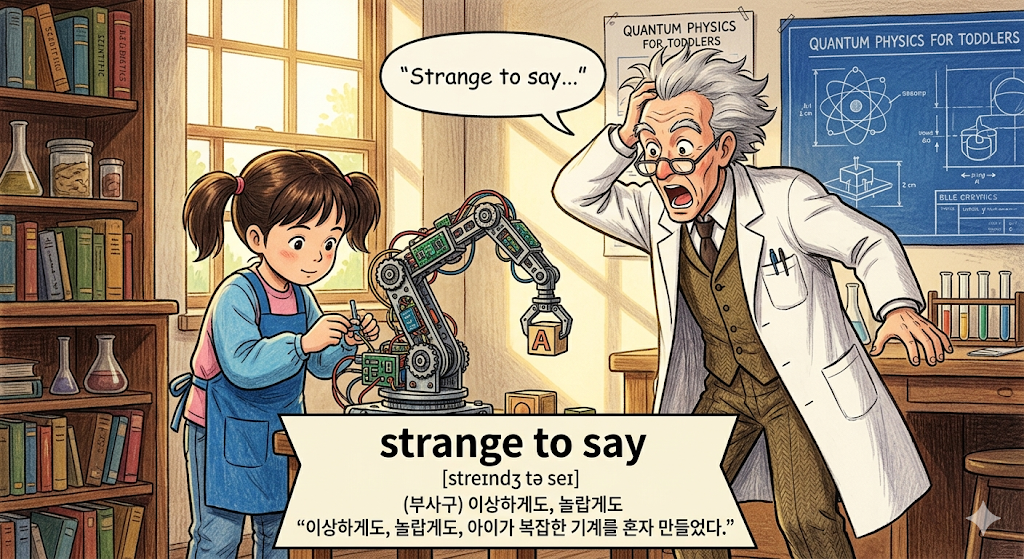
strange to say [streɪndʒ tə seɪ]
(부사구) 이상하게도, 놀랍게도
예상과 다른 사실이나 상황을 소개할 때 강조합니다. 수능 독해 심리·사회·일상 지문에서 자주 등장합니다.
- Strange to say, the students who had been most worried about the class trip ended up having the best time and were the last ones to get back on the bus at the end. (이상하게도, 수학여행에 가장 걱정했던 학생들이 결국 가장 즐거운 시간을 보내고 끝에 버스에 마지막으로 탔다.)
- Strange to say, the harder she tried to fall asleep, the more awake she felt, so she got up and read for thirty minutes and then had no trouble at all. (이상하게도, 잠들려고 더 열심히 할수록 더 깨어있는 느낌이 들어서 일어나 30분간 책을 읽고 나서 전혀 어려움이 없었다.)
- The essay used strange to say to introduce counterintuitive findings — arguing that the phrases we use to frame unexpected information shape how willing people are to hear it, and that acknowledging strangeness is often more persuasive than pretending an unusual fact is obvious. (에세이는 이상하게도를 사용해 직관에 반하는 발견을 소개했다 — 예상치 못한 정보를 구성하는 데 사용하는 표현들이 사람들이 그것을 들으려는 의지를 형성하며, 이상함을 인정하는 것이 종종 비정상적인 사실이 명백한 척하는 것보다 더 설득력 있다고 주장했다.)

feel strange [fiːl streɪndʒ]
(동사구) 이상하게 느끼다, 어색하게 느끼다
불편하거나 익숙하지 않은 상황에서 느끼는 감정을 강조합니다. 수능 독해 심리·일상 지문에서 자주 등장합니다.
- She felt strange wearing her school uniform for the last time on the final day, knowing that the following week everything about her life would be completely different. (그녀는 다음 주에 삶의 모든 것이 완전히 달라질 것을 알면서 마지막 날 처음으로 학교 교복을 입는 것이 이상하게 느껴졌다.)
- He felt strange being called by his first name by his new teacher, having spent six years at a school where teachers always used surnames. (그는 선생님들이 항상 성을 사용했던 학교에서 6년을 보내다가 새 선생님이 이름으로 부르는 것이 이상하게 느껴졌다.)
- The essay explored why people often feel strange when they get what they have always wanted — arguing that the absence of the thing we want is something we adapt to, so when it arrives we have lost the habit of having it and need time to readjust. (에세이는 사람들이 항상 원하던 것을 얻을 때 종종 이상하게 느끼는 이유를 탐구했다 — 원하는 것의 부재는 우리가 적응하는 것이기 때문에 그것이 도착하면 그것을 갖는 습관을 잃어 재조정할 시간이 필요하다고 주장했다.)
숙어 그룹 묶음 1 — 느낌·상황 strange 핵심 패턴
표현 의미 핵심 뉘앙스 주요 맥락
| strange to say | 이상하게도 | 예상과 다른 사실을 소개하는 것 | 심리·사회·수능 |
| feel strange | 이상하게 느끼다 | 불편하거나 낯선 상황의 감정 | 심리·일상·수능 |
| strange as it seems | 이상해 보이겠지만 | 믿기 어렵지만 사실인 것을 소개 | 학술·사회·수능 |
이 세 표현은 모두 strange의 "예상과 다르거나 익숙하지 않은" 이미지를 공유하되, 각각 예상과 다른 사실을 부드럽게 소개하는 것(strange to say)·내면에서 느끼는 낯선 감정(feel strange)·듣는 사람이 놀랄 수 있는 사실을 인정하며 소개하는 것(strange as it seems)의 관점에서 접근합니다.
- Strange to say, she felt strange when the very thing she had dreamed of finally happened — and, strange as it seems, that feeling of strangeness was what told her it was real. (이상하게도, 꿈꿔왔던 바로 그 일이 마침내 일어났을 때 그녀는 이상하게 느꼈다 — 그리고, 이상해 보이겠지만, 그 이상함의 느낌이 그것이 진짜라는 것을 알려주는 것이었다.)
- Strange as it seems, feeling strange in a new situation is actually a sign of health — and, strange to say, the people who never feel strange are often those who have stopped growing. (이상해 보이겠지만, 새로운 상황에서 이상하게 느끼는 것이 실제로 건강의 표시이다 — 그리고, 이상하게도, 결코 이상하게 느끼지 않는 사람들이 종종 성장을 멈춘 사람들이다.)
- The essay connected all three by arguing that strange to say, feeling strange, and strange as it seems are all ways of naming the honest discomfort of encountering something outside our experience — and that people who are willing to name that discomfort rather than hide it tend to learn more from it. (에세이는 이상하게도, 이상하게 느끼기, 그리고 이상해 보이겠지만이 모두 우리 경험 밖의 것을 만나는 솔직한 불편함에 이름을 붙이는 방법이라고 주장하며 세 가지를 연결했다 — 그리고 그 불편함을 숨기기보다 이름 붙이려는 의지가 있는 사람들이 그것에서 더 많이 배우는 경향이 있다고 했다.)

strange as it seems [streɪndʒ æz ɪt siːmz]
(접속사구) 이상해 보이겠지만, 어처구니없어 보이겠지만
듣는 사람이 믿기 어려울 수 있는 사실을 소개할 때 강조합니다. 수능 독해 학술·사회·논리 지문에서 자주 등장합니다.
- Strange as it seems, the students who spent less time studying but reviewed their notes more regularly performed better than those who studied for longer without reviewing. (이상해 보이겠지만, 공부 시간을 더 적게 보냈지만 노트를 더 규칙적으로 복습한 학생들이 복습 없이 더 오래 공부한 학생들보다 더 잘 수행했다.)
- Strange as it seems, she preferred the days when the weather was grey and rainy because the quiet streets and empty cafés made it easier to think clearly. (이상해 보이겠지만, 그녀는 날씨가 흐리고 비가 오는 날을 선호했는데 조용한 거리와 빈 카페들이 더 명확하게 생각하는 것을 더 쉽게 만들었기 때문이었다.)
- The essay argued that phrases like strange as it seems serve an important function in honest communication — they prepare the listener to hold a surprising truth without dismissing it, which is why good writers use them when they want the reader to stay open rather than sceptical. (에세이는 이상해 보이겠지만과 같은 표현이 솔직한 소통에서 중요한 기능을 한다고 주장했다 — 그것들이 청취자가 놀라운 진실을 무시하지 않고 받아들일 준비를 시키며, 이것이 좋은 작가들이 독자가 회의적이기보다 열린 마음을 유지하기를 원할 때 그것들을 사용하는 이유라고 했다.)

strange thing happened [streɪndʒ θɪŋ ˈhæpənd]
(동사구) 이상한 일이 생겼다, 신기한 일이 있었다
예상치 못한 특이한 사건을 이야기할 때 강조합니다. 수능 독해 문학·일상·심리 지문에서 자주 등장합니다.
- A strange thing happened at the end of the class — everyone who had been dreading the presentation said afterwards that it had been the best part of their week. (수업 말에 이상한 일이 생겼다 — 발표를 두려워했던 모든 사람이 나중에 그것이 한 주의 가장 좋은 부분이었다고 말했다.)
- A strange thing happened when she stopped checking the news every hour — she became better informed because she read longer articles rather than short updates, and felt calmer because she stopped treating everything as urgent. (매 시간 뉴스를 확인하는 것을 멈췄을 때 이상한 일이 생겼다 — 짧은 업데이트보다 더 긴 기사를 읽어서 더 잘 알게 됐고, 모든 것을 긴급하게 대하는 것을 멈춰서 더 차분하게 느꼈다.)
- The essay noted that strange things happen most often when people step outside their routines — and argued that this is not coincidence but cause, because new environments produce new encounters, and new encounters produce new possibilities. (이상한 일들은 사람들이 일상에서 벗어날 때 가장 자주 일어난다고 에세이는 지적했다 — 그리고 이것이 우연이 아니라 원인이라고 주장했는데, 새로운 환경이 새로운 만남을 만들고 새로운 만남이 새로운 가능성을 만들기 때문이다.)
숙어 그룹 묶음 2 — 사건·가능성 strange 패턴
표현 의미 핵심 뉘앙스 주요 맥락
| strange thing happened | 이상한 일이 생겼다 | 예상치 못한 특이한 사건 이야기 | 문학·일상·수능 |
| stranger things have happened | 더 이상한 일도 있었다 | 가능성을 열어두며 격려하는 것 | 일상·사회·수능 |
| strange but true | 이상하지만 사실이다 | 믿기 어렵지만 실제인 내용 소개 | 일상·학술·수능 |
이 세 표현은 모두 strange의 "예상을 벗어난 현실" 이미지를 공유하되, 각각 이미 일어난 예상치 못한 일(strange thing happened)·앞으로 가능한 예상 밖의 일(stranger things have happened)·놀랍지만 입증된 사실(strange but true)의 관점에서 접근합니다.
- Strange but true — a strange thing happened at exactly the moment she gave up hope, and looking back, she understood why people say stranger things have happened when they encourage someone to keep trying. (이상하지만 사실이다 — 그녀가 희망을 포기하는 정확한 순간에 이상한 일이 일어났으며, 돌이켜보면 사람들이 누군가에게 계속 시도하도록 격려할 때 더 이상한 일도 있었다고 말하는 이유를 이해했다.)
- The essay connected the three by arguing that strange but true describes the world as it is, that strange things happen is the experience of living in that world, and that stranger things have happened is the wisdom that results — the recognition that reality is always wider than we expect. (에세이는 이상하지만 사실이다가 있는 그대로의 세상을 묘사하고, 이상한 일들이 일어난다는 것이 그 세상에서 사는 경험이며, 더 이상한 일도 있었다는 것이 그 결과로 얻어지는 지혜 — 현실이 항상 우리가 예상하는 것보다 더 넓다는 인식 — 라고 주장하며 세 가지를 연결했다.)
- She concluded that strange but true, strange things happen, and stranger things have happened are three expressions that together make up a small philosophy of openness — an acceptance that the world will always exceed our categories and that this is something to welcome rather than resist. (그녀는 이상하지만 사실이다, 이상한 일들이 일어난다, 그리고 더 이상한 일도 있었다가 함께 개방성의 작은 철학을 이루는 세 가지 표현이라고 결론지었다 — 세상이 항상 우리의 범주를 초월할 것이며 이것이 저항하기보다 환영할 것이라는 수용이다.)

stranger things have happened [ˈstreɪndʒər θɪŋz hæv ˈhæpənd]
(관용구) 더 이상한 일도 있었다, 뭔들 안 되겠어
가능성이 낮아 보이는 것도 충분히 일어날 수 있다고 격려하거나 위로할 때 강조합니다. 수능 독해 일상·사회·심리 지문에서 자주 등장합니다.
- "Do you really think she will come back after everything that happened?" "I know it seems unlikely, but stranger things have happened — give her some time." ("그 모든 일이 있은 후에 그녀가 정말 돌아올 것 같아?" "가능성이 낮아 보이는 건 알지만, 더 이상한 일도 있었어 — 그녀에게 시간을 좀 줘.")
- She told her younger brother that winning from that position was almost impossible, but then added, "Almost — and stranger things have happened, so keep playing as hard as you can." (그녀는 남동생에게 그 위치에서 이기는 것은 거의 불가능하다고 말했지만, "거의 — 그리고 더 이상한 일도 있었으니까, 할 수 있는 한 열심히 계속 해"라고 덧붙였다.)
- The essay argued that stranger things have happened is one of the most encouraging phrases in the language — not because it promises success but because it refuses to close the door on possibility, which is exactly what someone needs when their confidence is low and their situation looks hopeless. (에세이는 더 이상한 일도 있었다가 언어에서 가장 격려적인 표현 중 하나라고 주장했다 — 성공을 약속하기 때문이 아니라 가능성의 문을 닫기를 거부하기 때문이며, 이것이 자신감이 낮고 상황이 희망이 없어 보일 때 누군가에게 필요한 것이라고 했다.)

strange but true [streɪndʒ bʌt truː]
(관용구) 이상하지만 사실이다
믿기 어렵지만 실제로 사실인 내용을 소개할 때 강조합니다. 수능 독해 학술·과학·일상 지문에서 자주 등장합니다.
- Strange but true — people who write down their goals are significantly more likely to achieve them than people who only think about them, because writing creates a different kind of commitment. (이상하지만 사실이다 — 목표를 적어두는 사람들이 단지 그것에 대해 생각하는 사람들보다 훨씬 더 달성할 가능성이 높은데, 글쓰기가 다른 종류의 헌신을 만들기 때문이다.)
- Strange but true — the country with the most hours of daylight in winter is not the warmest but one of the coldest, because the angle of the sun matters more than the length of the day. (이상하지만 사실이다 — 겨울에 일조 시간이 가장 많은 나라가 가장 따뜻한 것이 아니라 가장 추운 것 중 하나인데, 태양의 각도가 낮의 길이보다 더 중요하기 때문이다.)
- The essay noted that strange but true is most effective when used sparingly — because if everything is introduced this way, the phrase loses its power, and what should feel surprising begins to feel like a trick. (에세이는 이상하지만 사실이다가 아껴 사용할 때 가장 효과적이라고 지적했다 — 모든 것이 이런 식으로 소개되면 표현이 힘을 잃고, 놀랍게 느껴져야 할 것이 속임수처럼 느껴지기 시작하기 때문이다.)
숙어 그룹 묶음 3 — 경험·장소 strange 심화 패턴
표현 의미 핵심 뉘앙스 주요 맥락
| no stranger to | ~에 익숙한 | 어떤 상황에 매우 친숙한 것 | 학술·사회·수능 |
| strange land | 낯선 땅 | 익숙하지 않은 새로운 장소나 환경 | 문학·사회·수능 |
| it feels strange | 이상하게 느껴진다 | 상황이 예상과 달리 낯설게 느껴지는 것 | 심리·일상·수능 |
이 세 표현은 모두 strange의 "익숙하지 않은 것과의 관계" 이미지를 공유하되, 각각 충분히 경험해 더 이상 낯설지 않은 것(no stranger to)·물리적으로 낯선 장소(strange land)·심리적으로 낯설게 느껴지는 상황(it feels strange)의 관점에서 접근합니다.
- She was no stranger to starting over in a strange land, having moved three times before the age of twelve, but it still felt strange every time to walk into a new school and be the person nobody knew yet. (그녀는 12살이 되기 전에 세 번 이사해 낯선 땅에서 다시 시작하는 것에 익숙했지만, 새 학교에 걸어들어가 아직 아무도 모르는 사람이 되는 것은 매번 여전히 이상하게 느껴졌다.)
- The essay explored how being no stranger to difficulty does not make a strange land feel less strange — but argued that experience gives you the knowledge that the strangeness will pass, which changes how frightening it feels even when the feeling remains as strong. (에세이는 어려움에 익숙한 것이 낯선 땅을 덜 낯설게 느끼게 만들지 않는다고 탐구했다 — 하지만 경험이 낯섦이 사라질 것이라는 지식을 주며, 이것이 그 느낌이 여전히 강하게 남아있어도 얼마나 두렵게 느껴지는지를 바꾼다고 주장했다.)
- She concluded that it feels strange to arrive in a strange land, but that those who are no stranger to the experience know something important: that the strangeness is temporary, that the land will become familiar, and that the person who arrives confused and the person who leaves at home are the same person at different points in the same story. (그녀는 낯선 땅에 도착하는 것이 이상하게 느껴지지만, 그 경험에 익숙한 사람들은 중요한 것을 안다고 결론지었다: 낯섦은 일시적이고, 땅은 익숙해지며, 혼란스럽게 도착하는 사람과 집처럼 편안하게 떠나는 사람이 같은 이야기의 다른 시점에 있는 같은 사람이라는 것이다.)

no stranger to [nəʊ ˈstreɪndʒər tə]
(형용사구) ~에 익숙한, ~을 잘 아는, ~을 많이 경험한
어떤 상황이나 경험에 이미 매우 친숙하다는 것을 강조하며, 수능에서 자주 출제되는 표현입니다.
- She was no stranger to being underestimated, and had long since learned to use other people's low expectations as fuel rather than letting them become a ceiling. (그녀는 과소평가받는 것에 익숙했으며, 다른 사람들의 낮은 기대가 천장이 되도록 내버려두기보다 연료로 사용하는 것을 오래전에 배웠다.)
- The school was no stranger to difficult years, having survived several funding cuts and a change of leadership, which was why the staff were unusually calm when the next challenge arrived. (학교는 여러 번의 자금 삭감과 리더십 변화를 견뎌냈기 때문에 어려운 시간에 익숙했으며, 이것이 다음 도전이 왔을 때 직원들이 비정상적으로 침착했던 이유였다.)
- The essay argued that being no stranger to something is not the same as no longer being affected by it — and that the most honest kind of resilience is not the absence of struggle but the capacity to keep going while still feeling the weight of what you are carrying. (무언가에 익숙한 것이 더 이상 그것에 영향을 받지 않는 것과 같지 않다고 에세이는 주장했다 — 그리고 가장 솔직한 종류의 탄력성은 어려움의 부재가 아니라 짊어지고 있는 것의 무게를 여전히 느끼면서 계속 나아가는 능력이라고 했다.)

strange land [streɪndʒ lænd]
(명사구) 낯선 땅, 낯선 곳
익숙하지 않은 새로운 장소나 환경을 강조하며, 비유적으로 완전히 새로운 상황을 나타냅니다. 수능 독해 문학·사회·심리 지문에서 자주 등장합니다.
- She described her first year of university as arriving in a strange land where the language was almost the same but the rules were completely different from anything she had known before. (그녀는 대학교 첫 해를 언어는 거의 같지만 규칙이 이전에 알았던 것과 완전히 달랐던 낯선 땅에 도착하는 것으로 묘사했다.)
- He had always imagined that moving to the city would feel exciting, but when he arrived with two bags and no friends, it felt more like a strange land than the new beginning he had pictured. (그는 도시로 이사하는 것이 흥미롭게 느껴질 것이라고 항상 상상했지만, 두 개의 가방과 친구 없이 도착했을 때 그것은 상상했던 새로운 시작보다 낯선 땅처럼 더 느껴졌다.)
- The essay used a strange land as a metaphor for any situation that demands new ways of thinking — arguing that the discomfort of being in unfamiliar territory is not something to escape but something to move through, because the person you become on the other side is shaped entirely by how you choose to navigate the crossing. (에세이는 낯선 땅을 새로운 사고 방식을 요구하는 어떤 상황의 은유로 사용했다 — 익숙하지 않은 영역에 있는 불편함은 피해야 할 것이 아니라 통과해야 할 것이며, 반대편에서 되는 사람은 건너는 것을 어떻게 탐색하기로 선택했는지에 의해 완전히 형성된다고 주장했다.)

it feels strange [ɪt fiːlz streɪndʒ]
(동사구) 이상하게 느껴진다, 어색하게 느껴진다
어떤 상황이나 변화가 예상과 달리 불편하거나 낯설게 느껴지는 것을 강조합니다. 수능 독해 심리·일상·문학 지문에서 자주 등장합니다.
- It feels strange to be on the other side of the counter — to be the one asking questions rather than the one answering them — but she was getting used to the change faster than she had expected. (이상하게 느껴진다 — 답하는 사람이 아닌 질문하는 사람이 되는 것이 — 하지만 그녀는 예상보다 더 빠르게 변화에 익숙해지고 있었다.)
- It felt strange to be praised for something she had found easy — as if the praise was for someone else and she was simply in the room where it happened. (쉽다고 생각했던 것에 대해 칭찬받는 것이 이상하게 느껴졌다 — 마치 칭찬이 다른 사람을 위한 것이고 자신은 단지 그것이 일어난 방에 있었던 것처럼이다.)
- The essay explored why it feels strange when good things happen to people who have grown used to difficulty — arguing that we develop an emotional set point that feels normal, and that positive change is as disorienting as negative change until we have had time to recalibrate. (에세이는 어려움에 익숙해진 사람들에게 좋은 일이 일어날 때 왜 이상하게 느껴지는지 탐구했다 — 우리는 정상적으로 느껴지는 감정적 기준점을 개발하며, 긍정적인 변화는 재교정할 시간이 생길 때까지 부정적인 변화만큼 방향을 잃게 만든다고 주장했다.)
숙어 그룹 묶음 4 — 종합 strange 패턴
표현 의미 핵심 뉘앙스 주요 맥락
| no stranger to | ~에 익숙한 | 어떤 상황에 매우 친숙한 것 | 학술·사회·수능 |
| strange as it seems | 이상해 보이겠지만 | 믿기 어렵지만 사실인 것을 소개 | 학술·사회·수능 |
| stranger things have happened | 더 이상한 일도 있었다 | 가능성을 열어두며 격려하는 것 | 일상·사회·수능 |
이 세 표현은 수능 독해에서 가장 자주 출제되는 strange의 핵심 패턴입니다. no stranger to는 과거 경험을, strange as it seems는 역설적 진리를, stranger things have happened는 열린 가능성을 각각 나타냅니다.
- She was no stranger to being told something was impossible, so when the news arrived — strange as it seems — she felt calm, and when her friends said stranger things have happened to cheer her up, she already knew it was true. (그녀는 무언가가 불가능하다는 말을 듣는 것에 익숙했기 때문에 소식이 도착했을 때 — 이상해 보이겠지만 — 그녀는 차분하게 느꼈으며, 친구들이 그녀를 격려하기 위해 더 이상한 일도 있었다고 말했을 때 그녀는 이미 그것이 사실이라는 것을 알았다.)
- The essay argued that being no stranger to hardship, understanding that strange as it seems the hardest experiences often teach the most, and believing that stranger things have happened when others discourage you are three kinds of wisdom that build on each other — each one making the next easier to hold. (에세이는 고난에 익숙한 것, 이상해 보이겠지만 가장 어려운 경험이 종종 가장 많이 가르친다는 것을 이해하는 것, 그리고 다른 사람들이 낙담시킬 때 더 이상한 일도 있었다고 믿는 것이 서로를 기반으로 하는 세 종류의 지혜라고 주장했다 — 각각이 다음을 지지하기 더 쉽게 만든다고 했다.)
- She concluded that no stranger to, strange as it seems, and stranger things have happened together tell a story of someone who has been shaped by the unexpected, has learned to present difficult truths with grace, and has chosen to stay open to possibilities that others have already written off — which, strange as it seems, is one of the most reliable descriptions of anyone who has ever achieved something genuinely remarkable. (그녀는 익숙한, 이상해 보이겠지만, 그리고 더 이상한 일도 있었다가 함께 예상치 못한 것에 의해 형성되고, 어려운 진실을 품위 있게 제시하는 것을 배우며, 다른 사람들이 이미 포기한 가능성에 열린 마음을 유지하기로 선택한 사람의 이야기를 한다고 결론지었다 — 이상해 보이겠지만, 이것이 진정으로 놀라운 무언가를 달성한 사람의 가장 믿을 수 있는 묘사 중 하나라고 했다.)
전체 요약표
표현 의미 핵심 뉘앙스
| strange | 이상한, 낯선, 기이한 | 낯섦과 이상함의 핵심 이미지 |
| strange to say | 이상하게도 | 예상과 다른 사실을 소개하는 것 |
| feel strange | 이상하게 느끼다 | 불편하거나 낯선 상황의 감정 |
| strange as it seems | 이상해 보이겠지만 | 믿기 어렵지만 사실인 것을 소개 |
| strange thing happened | 이상한 일이 생겼다 | 예상치 못한 특이한 사건 이야기 |
| stranger things have happened | 더 이상한 일도 있었다 | 가능성을 열어두며 격려하는 것 |
| strange but true | 이상하지만 사실이다 | 믿기 어렵지만 실제인 내용 소개 |
| no stranger to | ~에 익숙한 | 어떤 상황에 매우 친숙한 것 |
| strange land | 낯선 땅 | 익숙하지 않은 새로운 장소나 환경 |
| it feels strange | 이상하게 느껴진다 | 상황이 예상과 달리 낯설게 느껴지는 것 |
유의어 비교표

단어 공통점 뉘앙스 차이 예문
| strange | 이상한, 낯선 | 익숙하지 않음·역설·경험, 비유 풍부 | A strange sound. |
| odd | 특이한 | 규칙에서 벗어난, 격식적 | An odd choice. |
| weird | 기묘한 | 설명 어렵고 매우 이상한, 비격식 | A weird feeling. |
| unusual | 흔치 않은 | 단순히 드문 것 | An unusual event. |
| peculiar | 독특한 | 특이하고 개성 있는 것 | A peculiar habit. |
유의어 예문 리스트
- (odd) It seemed odd to everyone at the table that he had ordered a starter but not a main course, but nobody asked because he had a way of looking like he did not want to be questioned. (그가 전채 요리를 주문했지만 메인 코스를 주문하지 않은 것이 테이블의 모든 사람에게 특이하게 보였지만, 그가 질문받고 싶지 않은 것처럼 보이는 방식이 있었기 때문에 아무도 묻지 않았다.)
- (weird) She had a weird habit of humming the same tune whenever she was concentrating, which her classmates had noticed but were too used to by now to find it strange. (그녀는 집중할 때마다 같은 곡조를 흥얼거리는 기묘한 습관이 있었으며, 반 친구들은 알아챘지만 이제 너무 익숙해서 이상하다고 생각하지 않았다.)
- (unusual) The school had made an unusual decision to replace the summer exam with a project, which most students welcomed but a few found unsettling because they were better at tests. (학교는 여름 시험을 프로젝트로 교체하는 흔치 않은 결정을 했는데, 대부분의 학생들은 환영했지만 일부는 시험에 더 능숙했기 때문에 불안하게 생각했다.)
- (peculiar) He had a peculiar way of solving maths problems that none of his teachers had ever seen before — working backwards from the answer — but it always produced the right result. (그는 어떤 선생님도 이전에 본 적 없는 독특한 방식으로 수학 문제를 풀었다 — 답에서 거꾸로 작업하는 것 — 하지만 항상 올바른 결과를 냈다.)
결론 정리
strange는 단순히 "이상한"이 아니라, 라틴어 extraneus(외부의)에서 출발해 밖에서 온, 익숙하지 않은 것에서 이상함·낯섦·어색함·역설적 진리·경험과 적응까지 확장되는 단어다 — strange가 있는 곳엔 언제나 '단순한 이상함이 아닌, 인간이 낯섦을 만나고·예상 밖의 진리를 발견하며·새로운 것에 적응하고·성장하는 방식이 생생하게 살아숨쉬는' 생동감의 선언이 있다.
💡 strange는 "밖에서 온, 익숙하지 않은 것에서 출발한" 생동감 넘치는 언어 — no stranger to · strange as it seems · stranger things have happened가 수능 최빈출.
🌟 초등학생 버전 — strange는 이상한, 낯선이지만, "~에 익숙한"(no stranger to), "이상하지만 사실"(strange but true), "더 이상한 일도 있었어"(stranger things have happened)처럼 우리 생활과 경험 곳곳에 살아있는 단어예요! 🌀✨


