- 분류 전체보기 (5709)

| 일 | 월 | 화 | 수 | 목 | 금 | 토 |
|---|---|---|---|---|---|---|
| 1 | 2 | 3 | 4 | 5 | ||
| 6 | 7 | 8 | 9 | 10 | 11 | 12 |
| 13 | 14 | 15 | 16 | 17 | 18 | 19 |
| 20 | 21 | 22 | 23 | 24 | 25 | 26 |
| 27 | 28 | 29 | 30 |
- Yes
- Actually
- Excuse me
- hold on
- Show Up
- Hey
- work out
- entrance fee
- I'm sorry
- get through
- please.
- make it
- Don't worry
- well
- please?
- Read between the lines
- OKay
- pick up
- too.
- set up
- By The Way
- Yeah
- come up with
- no
- Sorry
- I'm glad to hear that.
- Sure
- Please
- oh
- Right?
- Today
- Total
인과함께
Day441 , embrace, embrace change, embrace diversity, embrace the idea of, warmly embrace, embrace challenges, embrace technology, fully embrace, embrace differences, embrace the opportunity, embrace one's identity 본문
Day441 , embrace, embrace change, embrace diversity, embrace the idea of, warmly embrace, embrace challenges, embrace technology, fully embrace, embrace differences, embrace the opportunity, embrace one's identity
미인생 2026. 9. 21. 12:33
embrace [ɪmˈbreɪs]
(동사/명사) 껴안다, 포용하다, 받아들이다, 열정적으로 수용하다 / 포옹, 수용, 포용
단순히 "껴안다"로만 외우면 수능에서 반드시 틀립니다. embrace는 "어떤 것을 피하거나 거부하지 않고 팔을 벌려 환영하며 기꺼이 받아들이는 것, 마치 소중한 사람을 껴안듯이 어떤 생각이나 상황이나 사람을 완전히 수용하는 것" 이라는 핵심 이미지에서 출발해, 새로운 아이디어의 수용에서 변화 수용·다양성 포용·도전 받아들이기·정체성 인정까지 폭넓게 쓰이는 핵심 다의어입니다. 특히 embrace(포용하다) vs. accept(받아들이다) vs. adopt(채택하다) 의 뉘앙스 차이, embrace change(변화를 포용하다), fully embrace(완전히 받아들이다) 패턴은 수능 독해 사회·심리·교육·문화·과학 지문에서 핵심적으로 등장합니다.
'embrace'는 고대 프랑스어 embracer(팔로 안다)에서 유래했습니다. em(안으로)과 bras(팔)가 결합하여, 원래 "팔 안으로 가져오다, 즉 팔을 벌려 안는 것" 을 뜻했습니다. embrace의 핵심 이미지는 "팔을 벌려 환영하며 안는 것처럼 어떤 것을 거부하거나 밀어내지 않고 열정적이고 완전하게 가슴으로 받아들이는 것" 으로, 이 이미지에서 새로운 아이디어 수용·변화 환영·다양성 포용·도전 받아들이기·정체성 인정이 모두 확장되었습니다.
1. embrace change [ɪmˈbreɪs tʃeɪndʒ]
(사회/심리/수능) "변화를 포용하다, 변화를 받아들이다"를 뜻합니다. 새로운 상황이나 방식을 두려워하거나 거부하지 않고 열린 마음으로 환영하는 것을 강조합니다. 수능 독해 사회·심리·교육 지문의 핵심 표현입니다.
Students who learn to embrace change early in life tend to cope much better with the unpredictable challenges of adulthood than those who expect things to remain the same and feel anxious whenever their routines are disrupted. (변화를 포용하는 것을 일찍 배우는 학생들은 일이 동일하게 유지되기를 기대하고 일과가 방해받을 때마다 불안해하는 학생들보다 성인기의 예측 불가능한 도전에 훨씬 더 잘 대처하는 경향이 있다.)
2. embrace diversity [ɪmˈbreɪs daɪˈvɜːrsɪti]
(사회/교육/수능) "다양성을 포용하다, 다양함을 환영하다"를 뜻합니다. 서로 다른 배경이나 의견이나 방식을 문제로 보지 않고 풍요로움의 원천으로 환영하는 것을 강조합니다. 수능 독해 사회·교육·문화 지문의 핵심 표현입니다.
Schools that genuinely embrace diversity create environments where students from all backgrounds feel seen and valued, which research suggests leads not just to better social outcomes but to higher academic achievement for everyone in the classroom. (진정으로 다양성을 포용하는 학교들은 모든 배경의 학생들이 보이고 가치 있게 여겨진다고 느끼는 환경을 만드는데 연구에 따르면 이것은 더 나은 사회적 결과만이 아니라 교실의 모든 학생의 더 높은 학업 성취로 이어진다고 한다.)
3. embrace the idea of [ɪmˈbreɪs ðə aɪˈdiːə əv]
(교육/사회/수능) "~라는 아이디어를 받아들이다, ~라는 생각을 포용하다"를 뜻합니다. 처음에는 낯설거나 어려운 개념이나 생각을 열린 마음으로 수용하는 것을 강조합니다. 수능 독해 교육·사회·과학 지문의 핵심 표현입니다.
It took many scientists decades to fully embrace the idea of continental drift, partly because the evidence seemed too strange to believe and partly because accepting it would have required them to abandon theories they had spent years developing and defending. (많은 과학자들이 대륙 이동이라는 아이디어를 완전히 받아들이기까지 수십 년이 걸렸는데 부분적으로는 증거가 너무 이상해서 믿기 어려웠기 때문이고 부분적으로는 그것을 받아들이면 수년간 개발하고 방어해온 이론들을 포기해야 했기 때문이다.)
4. warmly embrace [ˈwɔːrmli ɪmˈbreɪs]
(사회/문학/수능) "따뜻하게 받아들이다, 진심으로 환영하다"를 뜻합니다. 단순히 수용하는 것을 넘어 진심 어린 온기와 열정으로 환영하는 것을 강조합니다. 수능 독해 사회·문학·교육 지문에서 자주 등장합니다.
The small town warmly embraced the group of international students who had come to stay for the semester, with local families inviting them for meals, and residents going out of their way to show them the best the area had to offer. (작은 마을은 한 학기 동안 머물기 위해 온 국제 학생 그룹을 따뜻하게 환영하여 지역 가정들이 그들을 식사에 초대하고 주민들이 지역이 제공할 수 있는 최고를 보여주기 위해 특별히 애썼다.)
5. embrace challenges [ɪmˈbreɪs ˈtʃælɪndʒɪz]
(심리/교육/수능) "도전을 받아들이다, 어려움을 포용하다"를 뜻합니다. 어려운 상황을 피하거나 두려워하지 않고 성장의 기회로 기꺼이 맞이하는 것을 강조합니다. 수능 독해 심리·교육·사회 지문의 핵심 표현입니다.
Athletes who embrace challenges rather than avoiding difficult training tend to improve faster than those who always choose the comfortable option, because real growth requires putting yourself in situations where failure is genuinely possible. (어려운 훈련을 피하기보다 도전을 받아들이는 선수들은 항상 편안한 선택을 하는 선수들보다 더 빠르게 향상되는 경향이 있는데 진정한 성장은 실패가 진정으로 가능한 상황에 자신을 놓는 것을 필요로 하기 때문이다.)
6. embrace technology [ɪmˈbreɪs tekˈnɒlədʒi]
(사회/과학/수능) "기술을 받아들이다, 기술 변화를 포용하다"를 뜻합니다. 새로운 기술이나 도구를 거부하거나 두려워하지 않고 열린 마음으로 활용하려는 것을 강조합니다. 수능 독해 사회·과학·교육 지문의 핵심 표현입니다.
Older workers who embrace technology rather than viewing it as a threat to their expertise often find that it enhances their effectiveness rather than replacing what they know, combining their experience with new tools to produce results that neither alone could achieve. (기술을 전문성에 대한 위협으로 보기보다 기술을 받아들이는 나이 든 노동자들은 종종 그것이 자신이 아는 것을 대체하기보다 효과성을 향상시킨다는 것을 발견하며 경험과 새로운 도구를 결합하여 어느 것도 혼자서는 달성할 수 없는 결과를 만든다.)
7. fully embrace [ˈfʊli ɪmˈbreɪs]
(심리/사회/수능) "완전히 받아들이다, 전적으로 포용하다"를 뜻합니다. 어떤 것을 부분적이 아닌 완전하고 전면적으로 수용하는 것을 강조합니다. 수능 독해 심리·사회·교육 지문에서 자주 등장합니다.
It is one thing to intellectually understand a new philosophy and quite another to fully embrace it in the way you live — because truly changing how you act requires not just new ideas but new habits, and habits are only formed through consistent practice over time. (새로운 철학을 지적으로 이해하는 것과 살아가는 방식에서 그것을 완전히 받아들이는 것은 전혀 다른 것이다 — 정말로 행동 방식을 바꾸는 것은 새로운 아이디어만이 아니라 새로운 습관을 필요로 하고 습관은 시간이 지나면서 일관된 연습을 통해서만 형성되기 때문이다.)
8. embrace differences [ɪmˈbreɪs ˈdɪfrənsɪz]
(사회/교육/수능) "차이를 포용하다, 다름을 환영하다"를 뜻합니다. 자신과 다른 사람들의 특성이나 관점을 문제가 아닌 가치 있는 것으로 환영하는 것을 강조합니다. 수능 독해 사회·교육·문화 지문에서 자주 등장합니다.
Teams that embrace differences in thinking styles, backgrounds, and approaches to problem-solving consistently outperform more homogeneous groups, because disagreement and variety of perspective, when channelled constructively, generate better solutions than consensus among like-minded people. (차이를 포용하는 팀들 — 사고 방식, 배경, 문제 해결 접근 방식에서의 — 은 일관되게 더 동질적인 그룹보다 뛰어난 성과를 내는데 의견 불일치와 관점의 다양성이 건설적으로 활용될 때 같은 생각을 가진 사람들 사이의 합의보다 더 나은 해결책을 만들어내기 때문이다.)
9. embrace the opportunity [ɪmˈbreɪs ðə ˌɒpəˈtjuːnɪti]
(사회/심리/수능) "기회를 받아들이다, 기회를 적극적으로 잡다"를 뜻합니다. 기회가 왔을 때 망설이거나 두려워하지 않고 열정적으로 잡는 것을 강조합니다. 수능 독해 사회·심리·교육 지문의 핵심 표현입니다.
She had always dreamed of studying abroad but kept finding reasons to delay, until her mentor told her directly that she needed to embrace the opportunity while it existed rather than waiting for a perfect moment that might never come. (그녀는 항상 해외에서 공부하는 것을 꿈꿨지만 계속 지연하는 이유를 찾았는데 멘토가 결코 오지 않을 수 있는 완벽한 순간을 기다리기보다 존재하는 동안 기회를 받아들여야 한다고 직접 말해줬다.)
10. embrace one's identity [ɪmˈbreɪs wʌnz aɪˈdentɪti]
(심리/사회/수능) "자신의 정체성을 받아들이다, 자신을 포용하다"를 뜻합니다. 자신의 특성이나 배경이나 본모습을 부끄러워하거나 숨기지 않고 온전히 수용하는 것을 강조합니다. 수능 독해 심리·사회·교육 지문의 핵심 표현입니다.
Young people who are encouraged to embrace their identity — including the parts that make them different from those around them — tend to develop greater resilience and a stronger sense of purpose than those who are pressured to conform to a narrow definition of what is considered normal. (자신의 정체성을 받아들이도록 장려받는 — 주변 사람들과 다르게 만드는 부분들을 포함하여 — 젊은 사람들은 정상으로 여겨지는 것의 좁은 정의에 맞도록 압박받는 사람들보다 더 큰 회복탄력성과 더 강한 목적 의식을 개발하는 경향이 있다.)
대한민국 입시 및 학술 주요 POINT
POINT 1. embrace vs. accept vs. adopt — 수능 최빈출 뉘앙스 구별
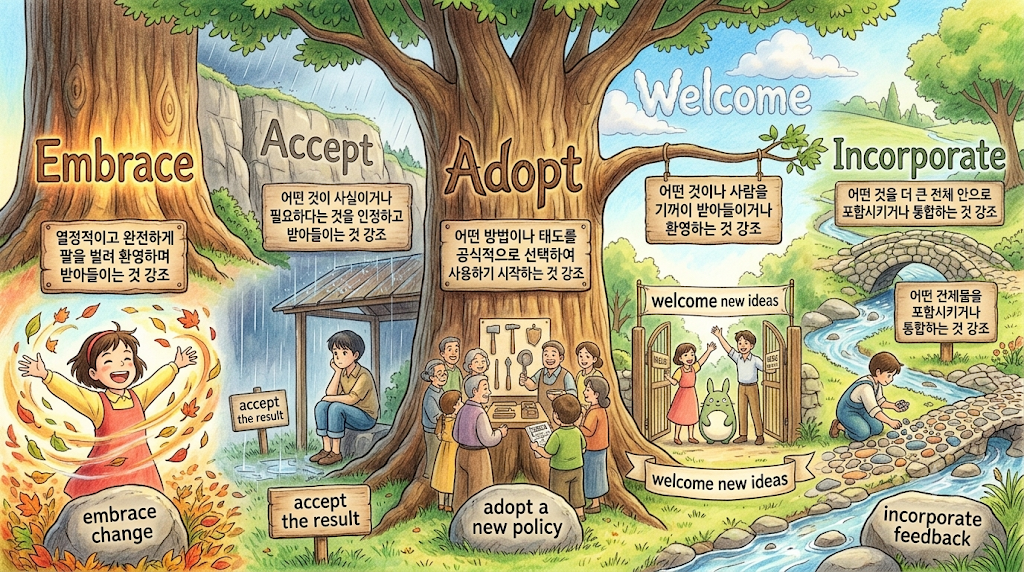
세 단어 모두 "받아들이다"와 관련되지만 뉘앙스가 다릅니다. embrace → 팔을 벌려 환영하며 껴안듯이 어떤 것을 열정적이고 완전하게 기꺼이 수용하는 것 (열정적 수용·환영·완전한 받아들임 강조) accept → 어떤 것이 사실이거나 필요하다는 것을 인정하고 마음으로 받아들이는 것, 반드시 열정적이지는 않음 (인정·동의·수동적 수용 강조) adopt → 어떤 방법이나 태도나 관행을 공식적으로 선택하여 사용하기 시작하는 것 (선택·도입·공식적 수용 강조) 예) She embraced the new teaching method with great enthusiasm. (그녀는 새로운 교수법을 큰 열정으로 포용했다.) — 열정적이고 완전한 수용 He accepted the situation even though he was not happy about it. (그는 기쁘지 않더라도 상황을 받아들였다.) — 인정하는 수용 The school adopted a new grading system from next term. (학교는 다음 학기부터 새로운 성적 시스템을 도입했다.) — 공식적 선택과 도입
POINT 2. embrace change / embrace challenges / fully embrace — 수능 심리·사회 지문 핵심
세 표현 모두 embrace의 "열정적으로 수용하는" 이미지를 공유하지만 맥락이 다릅니다. embrace change → 새로운 상황이나 방식을 두려워하거나 거부하지 않고 열린 마음으로 환영하는 것 (변화 환영·유연성·적응력 강조) embrace challenges → 어려운 상황을 피하거나 두려워하지 않고 성장의 기회로 기꺼이 맞이하는 것 (도전 수용·성장 마인드·용기 강조) fully embrace → 어떤 것을 부분적이 아닌 완전하고 전면적으로 수용하는 것 (완전성·전면적 수용·온전한 받아들임 강조) 이 세 표현이 등장하면 글쓴이가 수용의 태도와 마음가짐을 논하고 있다는 신호입니다.
POINT 3. embrace 어근 확장 — 수능 어휘 확장 필수
고대 프랑스어 embracer(팔로 안다)에서 유래한 단어들이 수능에서 자주 출제됩니다. embrace [ɪmˈbreɪs] → 껴안다, 포용하다, 받아들이다 / 포옹, 포용 embracing [ɪmˈbreɪsɪŋ] → 포용하는, 받아들이는 embraced [ɪmˈbreɪst] → 포용된, 받아들여진 all-embracing [ˌɔːlɪmˈbreɪsɪŋ] → 모든 것을 포함하는, 포괄적인 self-embrace [selfɪmˈbreɪs] → 자기 수용, 스스로를 받아들임 이 단어들은 모두 "팔을 벌려 안듯이 열정적으로 받아들이는" 공통 이미지에서 시작합니다.
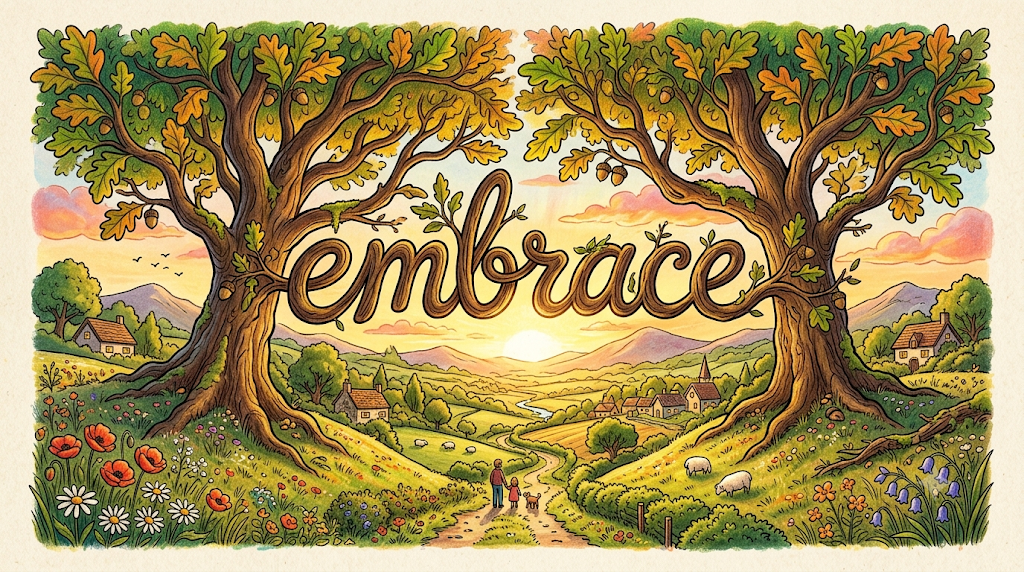
(동사) ① 껴안다, 포옹하다 (신체적)
embrace의 가장 기본적인 의미로, 팔을 벌려 누군가를 안는 것을 나타냅니다.
- When Minjun finally came home after six months studying abroad, his mother ran to the door and embraced him so tightly that he laughed and said he could not breathe, while she cried into his shoulder and said she had missed him every single day. (민준이 6개월간의 해외 유학 후 마침내 집으로 돌아왔을 때 그의 어머니는 문으로 달려와 그를 너무 꽉 껴안아서 그는 숨을 쉴 수 없다고 웃으며 말했고 그녀는 그의 어깨에 얼굴을 묻고 매일 그리웠다고 울었다.)
- The two old friends embraced warmly at the airport when they saw each other for the first time in five years, both surprised by how little the other seemed to have changed and how immediately comfortable it felt to be in each other's company again. (두 오랜 친구는 5년 만에 처음으로 서로를 봤을 때 공항에서 따뜻하게 껴안으며 상대방이 얼마나 변하지 않아 보이는지와 다시 서로의 곁에 있는 것이 얼마나 즉시 편안하게 느껴지는지에 둘 다 놀랐다.)
- After winning the championship, the whole team embraced each other on the court, some crying, some laughing, all of them feeling the weight of the months of training and sacrifice that had made the moment possible. (챔피언십에서 우승한 후 전체 팀이 코트에서 서로 껴안으며 일부는 울고 일부는 웃으며 그 순간을 가능하게 만든 수개월의 훈련과 희생의 무게를 모두 느꼈다.)

(동사) ② 포용하다, 열정적으로 받아들이다 (생각·상황·변화)
어떤 생각이나 기회나 상황을 두려워하거나 거부하지 않고 열정적으로 수용하는 것을 나타냅니다. 수능 독해 심리·사회·교육 지문에서 가장 자주 등장합니다.
- The new principal embraced the idea that every student had the potential to succeed and set about restructuring the school's systems to reflect that belief, removing practices that had been sorting students into those expected to do well and those not expected to. (새 교장은 모든 학생이 성공할 잠재력이 있다는 생각을 받아들이고 그 믿음을 반영하도록 학교 시스템을 재구성하기 시작하여 잘 할 것으로 기대되는 학생과 그렇지 않은 학생을 분류해온 관행들을 없앴다.)
- What distinguished the most successful companies during the period of rapid digitalisation was not their size or their existing resources but their willingness to embrace uncertainty and try new approaches before it was clear which ones would work. (급격한 디지털화 시기에 가장 성공적인 회사들을 구분 지은 것은 그들의 규모나 기존 자원이 아니라 불확실성을 받아들이고 어느 것이 효과가 있을지 명확해지기 전에 새로운 접근 방식을 시도하려는 의지였다.)
- It is easier to embrace imperfection in others than in ourselves, which is why the advice to be kinder to yourself is both simple to give and genuinely difficult to follow — it requires accepting the same flaws in yourself that you would readily forgive in a friend. (다른 사람에게서의 불완전함을 자신에게서보다 받아들이기 더 쉬운데 이것이 자신에게 더 친절하라는 조언이 주기는 간단하지만 실제로 따르기는 어려운 이유이다 — 친구에게서는 기꺼이 용서할 같은 결함을 자신에게서 받아들이는 것을 필요로 하기 때문이다.)

(명사) ③ 포옹, 포용, 수용
껴안는 행위나 어떤 것을 열정적으로 받아들이는 상태를 나타냅니다.
- The city's embrace of cycling as a serious form of transport — not just a leisure activity — had transformed its streets over twenty years from car-dominated roads into places where people of all ages felt safe and comfortable moving around without a vehicle. (자전거를 단순한 여가 활동이 아닌 진지한 교통 수단으로서 도시의 수용이 20년에 걸쳐 자동차 지배적인 도로에서 모든 연령대의 사람들이 차량 없이 이동하는 것을 안전하고 편안하게 느끼는 장소로 거리를 변화시켰다.)
- Her embrace of minimalism had started as an attempt to declutter her apartment but had gradually become a broader philosophy that affected everything from how she spent her time to the relationships she chose to invest in. (그녀의 미니멀리즘 수용은 아파트를 정리하려는 시도로 시작됐지만 점차 시간을 어떻게 보내는지부터 투자하기로 선택한 관계까지 모든 것에 영향을 미치는 더 넓은 철학이 됐다.)
- The community's embrace of the newcomers was not instant — it took several seasons of shared work, shared meals, and the gradual building of trust before the boundary between insider and outsider began to dissolve in any meaningful way. (지역 사회의 새로운 사람들에 대한 포용은 즉각적이지 않았다 — 내부인과 외부인 사이의 경계가 의미 있는 방식으로 사라지기 시작하기 전에 몇 계절의 공유된 작업, 공유된 식사, 그리고 신뢰의 점진적인 형성이 필요했다.)
뉘앙스·의미 연결 흐름 표
핵심 이미지 연결 흐름 뉘앙스 요약
| 팔을 벌려 환영하며 껴안듯이 어떤 것을 거부하거나 밀어내지 않고 열정적이고 완전하게 가슴으로 받아들이는 것 | 신체적 포옹 → 생각의 수용 → 변화 환영 → 다양성 포용 → 정체성 수용 | 열린 팔로 기꺼이 맞이하는 이미지 |
| 수용의 강도 | accept → embrace → warmly embrace | 인정→포용→따뜻한 환영의 이미지 |
| 수용의 완전성 | partly embrace → embrace → fully embrace | 부분적→일반적→완전한의 이미지 |
어원 흐름 표
단어 구성 요소 의미 연결 흐름 뉘앙스 요약
| 고대 프랑스어 em (안으로) + bras (팔) → embracer | 팔 안으로 가져오다 → 팔로 안다 → 포용하다·받아들이다 | 팔을 벌려 환영하며 안듯이 열정적으로 받아들이는 핵심 이미지 |
| embrace (동사→명사→형용사·embracing→부사·embracingly) | 껴안다·포용하다 → 포옹·포용 → 포용하는 | 열린 팔로 기꺼이 맞이하는 이미지에서 다양한 맥락으로 완성 |
품사별 의미 표
품사 의미 예문
| 동사 | 껴안다, 포옹하다 | embrace a friend (친구를 껴안다) |
| 동사 | 포용하다, 열정적으로 받아들이다 | embrace change (변화를 포용하다) |
| 동사 | 기꺼이 수용하다 | embrace the opportunity (기회를 받아들이다) |
| 명사 | 포옹 | a warm embrace (따뜻한 포옹) |
| 명사 | 포용, 수용 | the embrace of new ideas (새로운 아이디어의 수용) |
활용 예문 리스트
- The company's decision to embrace remote working rather than resisting it allowed them to recruit talented people from anywhere in the world, not just those who could afford to live in the expensive city where their offices were located. (회사가 원격 근무에 저항하기보다 포용하기로 한 결정은 사무실이 위치한 비싼 도시에 살 여유가 있는 사람만이 아닌 전 세계 어디서든 재능 있는 사람들을 채용할 수 있게 했다.)
- Children who are taught to embrace failure as a source of information rather than a source of shame develop what researchers call a growth mindset — the belief that ability is not fixed but can be improved through effort and learning from mistakes. (실패를 수치의 원천이 아닌 정보의 원천으로 받아들이도록 가르침받은 아이들은 연구자들이 성장 마인드셋이라고 부르는 것 — 능력이 고정된 것이 아니라 노력과 실수로부터의 학습을 통해 개선될 수 있다는 믿음 — 을 개발한다.)
- His embrace of simplicity extended even to his language — he believed that complicated words and long sentences were usually a sign that a writer was trying to hide uncertainty behind impressive-sounding vocabulary rather than actually having something clear to say. (단순함에 대한 그의 포용은 언어에까지 확장됐다 — 그는 복잡한 단어와 긴 문장이 보통 작가가 실제로 명확하게 말할 것이 있는 것이 아니라 인상적으로 들리는 어휘 뒤에 불확실성을 숨기려 한다는 신호라고 믿었다.)
- The scientific community's gradual embrace of findings that contradicted established theories was slow and sometimes painful, but it was ultimately this willingness to revise understanding in the light of new evidence that made science such a reliable way of building knowledge over time. (확립된 이론과 모순되는 발견에 대한 과학 공동체의 점진적인 수용은 느리고 때로 고통스러웠지만 궁극적으로 시간이 지나면서 지식을 쌓는 그렇게 신뢰할 수 있는 방법으로 과학을 만든 것은 새로운 증거에 비추어 이해를 수정하려는 이 의지였다.)
- Embracing the discomfort of not knowing the answer — resisting the urge to fill silence with guesses or to pretend certainty where none exists — is one of the most valuable intellectual habits anyone can develop, whether they are a student in a classroom or a leader making decisions. (답을 모르는 불편함을 받아들이는 것 — 침묵을 추측으로 채우거나 확실성이 없는 곳에서 확실한 척하려는 충동에 저항하는 것 — 은 교실의 학생이든 결정을 내리는 지도자든 누구나 개발할 수 있는 가장 가치 있는 지적 습관 중 하나이다.)
전체 뉘앙스 설명
embrace는 '팔을 벌려 환영하며 껴안듯이 어떤 것을 거부하거나 밀어내지 않고 열정적이고 완전하게 가슴으로 받아들이는 것에서 출발하는 모든 신체적 포옹·생각의 수용·변화 환영·다양성 포용·정체성 수용의 언어'입니다.
accept와의 차이: accept는 어떤 것이 사실이거나 필요하다는 것을 인정하고 마음으로 받아들이는 것을 강조하고, embrace는 더 강하게 팔을 벌려 환영하듯이 열정적이고 기꺼이 수용하는 것을 강조합니다. adopt와의 차이: adopt는 어떤 방법이나 태도를 공식적으로 선택하여 사용하기 시작하는 것을 강조하고, embrace는 더 감정적이고 열정적으로 어떤 것을 완전히 수용하는 것을 강조합니다. welcome과의 차이: welcome은 어떤 것을 기꺼이 받아들이거나 인사하는 것을 강조하고, embrace는 더 깊게 완전히 자신의 것으로 만들어 포용하는 것을 강조합니다.
마지막 핵심 정리
embrace는 단순히 "껴안다"가 아닙니다 — 고대 프랑스어 embracer(팔로 안다)에서 출발해, 변화를 포용하다(embrace change)·다양성을 포용하다(embrace diversity)·~라는 아이디어를 받아들이다(embrace the idea of)·따뜻하게 받아들이다(warmly embrace)·도전을 받아들이다(embrace challenges)·기술을 받아들이다(embrace technology)·완전히 받아들이다(fully embrace)·차이를 포용하다(embrace differences)·기회를 받아들이다(embrace the opportunity)·자신의 정체성을 받아들이다(embrace one's identity)까지 확장되는 단어이며, embrace vs. accept vs. adopt의 뉘앙스 구별·embrace change·fully embrace·embrace diversity 패턴이 수능 핵심 출제 포인트입니다.
파생어 표 (발음기호 포함)
파생어 발음기호 품사 의미
| embracing | [ɪmˈbreɪsɪŋ] | 형용사/현재분사 | 포용하는, 받아들이는 |
| embraced | [ɪmˈbreɪst] | 형용사/과거분사 | 포용된, 받아들여진 |
| all-embracing | [ˌɔːlɪmˈbreɪsɪŋ] | 형용사 | 모든 것을 포함하는, 포괄적인 |
| embracement | [ɪmˈbreɪsmənt] | 명사 | 포옹, 수용 (드문 표현) |
| self-embrace | [selfɪmˈbreɪs] | 명사 | 자기 수용, 스스로를 받아들임 |
유의어 비교표
단어 공통점 뉘앙스 차이 예문
| embrace | 수용 관련 | 열정적이고 완전하게 팔을 벌려 환영하며 받아들이는 것 강조 | embrace change |
| accept | 수용 관련 | 어떤 것이 사실이거나 필요하다는 것을 인정하고 받아들이는 것 강조 | accept the result |
| adopt | 수용 관련 | 어떤 방법이나 태도를 공식적으로 선택하여 사용하기 시작하는 것 강조 | adopt a new policy |
| welcome | 수용 관련 | 어떤 것이나 사람을 기꺼이 받아들이거나 환영하는 것 강조 | welcome new ideas |
| incorporate | 수용 관련 | 어떤 것을 더 큰 전체 안으로 포함시키거나 통합하는 것 강조 | incorporate feedback |
유의어 예문 리스트
- (accept) After a long period of resisting the doctor's advice, he finally accepted that his lifestyle would need to change significantly if he wanted to avoid more serious health problems in the future — not enthusiastically, but with a resignation that was at least a starting point. (의사의 조언에 오랫동안 저항한 후 그는 미래에 더 심각한 건강 문제를 피하고 싶다면 생활 방식이 크게 바뀌어야 한다는 것을 마침내 받아들였다 — 열정적이지는 않지만 적어도 출발점인 체념으로.)
- (adopt) The school decided to adopt a new approach to homework after research showed that the traditional model of daily assignments was creating stress without producing the learning benefits that justified the time it required. (학교는 전통적인 일일 과제 모델이 필요한 시간을 정당화하는 학습 혜택 없이 스트레스를 만들고 있다는 연구가 보여준 후 숙제에 대한 새로운 접근 방식을 도입하기로 결정했다.)
- (welcome) The scientific community welcomed the new study's findings, though most researchers noted that further investigation would be needed before the results could be treated as definitive rather than interesting and worth pursuing. (과학 공동체는 새 연구의 발견을 환영했지만 대부분의 연구자들은 결과가 흥미롭고 추구할 가치가 있는 것이 아닌 결정적인 것으로 다뤄지기 전에 추가 조사가 필요할 것이라고 언급했다.)
- (incorporate) The revised version of the report incorporated suggestions from three separate reviewers, which meant that some sections had been substantially rewritten while others remained unchanged, reflecting the varied weight given to different pieces of feedback. (보고서의 개정된 버전은 세 명의 별도 검토자들의 제안을 통합했으며 이것은 일부 섹션이 상당히 다시 쓰여진 반면 다른 것들은 변경되지 않은 채로 남아 다른 피드백에 부여된 다양한 비중을 반영한다는 것을 의미했다.)
결론 정리
embrace는 단순히 "껴안다"가 아니라, 팔을 벌려 환영하며 껴안듯이 어떤 것을 거부하거나 밀어내지 않고 열정적이고 완전하게 가슴으로 받아들이는 이미지에서 출발해 변화를 포용하다·다양성을 포용하다·~라는 아이디어를 받아들이다·따뜻하게 받아들이다·도전을 받아들이다·기술을 받아들이다·완전히 받아들이다·차이를 포용하다·기회를 받아들이다·자신의 정체성을 받아들이다까지 확장되는 단어다 — embrace가 있는 곳엔 언제나 '팔을 벌려 환영하며 안듯이 두려워하거나 거부하지 않고 열정적으로 가슴으로 받아들이는' 포용과 환영의 이미지가 있다.
💡 embrace는 "팔을 벌려 환영하며 껴안듯이 어떤 것을 열정적이고 완전하게 기꺼이 받아들이는 것을 가리키는" 단어 — embrace change·fully embrace·embrace diversity 가 수능 최빈출. accept(인정하는 수용)·adopt(공식적 도입)와의 구별이 핵심 출제 포인트.
🌟 초등학생 버전 embrace는 단순히 "껴안다"가 아니에요! embrace change는 새 학기에 새 반이 됐을 때 불안해하거나 싫다고 하지 않고 "좋아, 새 친구들을 사귀자!"라고 팔을 벌려 기쁘게 맞이하는 것처럼 새로운 상황을 두려워하거나 거부하지 않고 열린 마음으로 기꺼이 환영하는 것이고, embrace differences는 나와 취미가 전혀 다른 친구를 "너 정말 신기하고 재밌는 것 좋아하네, 나도 배워볼게!"라고 반기는 것처럼 자신과 다른 점을 문제로 보지 않고 오히려 흥미롭고 가치 있는 것으로 환영하는 것이에요! 🌍✨

embrace change [ɪmˈbreɪs tʃeɪndʒ]
품사/뉘앙스 설명
(동사구) 변화를 포용하다, 변화를 받아들이다
새로운 상황이나 방식을 두려워하거나 거부하지 않고 열린 마음으로 환영하는 것을 강조합니다. 변화가 위협이 아닌 기회로 보인다는 것이 핵심 뉘앙스입니다. 수능 독해 사회·심리·교육 지문의 핵심 표현입니다.
- Businesses that embrace change as a normal and even welcome part of operating in competitive markets tend to be more agile and better at spotting opportunities than those that treat any deviation from established routines as a threat to be managed and minimised. (변화를 포용하는 사업체들 — 경쟁 시장에서 운영하는 정상적이고 심지어 환영받는 부분으로서 — 은 확립된 일과에서 어떤 이탈이든 관리하고 최소화해야 할 위협으로 취급하는 사업체들보다 더 민첩하고 기회를 발견하는 데 더 뛰어난 경향이 있다.)
- The hardest people to convince to embrace change are often not those who dislike the new thing being proposed but those who built the old system and therefore have both emotional investment in it and genuine expertise that makes them well-placed to see what might go wrong with the replacement. (변화를 포용하도록 설득하기 가장 어려운 사람들은 종종 제안된 새로운 것을 싫어하는 사람들이 아니라 기존 시스템을 구축하고 따라서 그것에 감정적인 투자를 하고 대체물에서 잘못될 수 있는 것을 볼 수 있는 좋은 위치에 있는 진정한 전문성을 가진 사람들이다.)
- Teaching children to embrace change does not mean teaching them that all change is good — it means teaching them to evaluate change on its merits, to adapt when adaptation is necessary, and to distinguish between changes that require resistance and those that offer genuine opportunity. (아이들에게 변화를 포용하도록 가르치는 것은 모든 변화가 좋다고 가르치는 것을 의미하지 않는다 — 그것은 그들에게 변화를 장점에 따라 평가하고, 적응이 필요할 때 적응하며, 저항이 필요한 변화와 진정한 기회를 제공하는 변화를 구별하도록 가르치는 것을 의미한다.)

embrace diversity [ɪmˈbreɪs daɪˈvɜːrsɪti]
품사/뉘앙스 설명
(동사구) 다양성을 포용하다, 다양함을 환영하다
서로 다른 배경이나 의견이나 방식을 문제로 보지 않고 풍요로움의 원천으로 환영하는 것을 강조합니다. 다양성이 가치 있다는 인식이 핵심 뉘앙스입니다. 수능 독해 사회·교육·문화 지문의 핵심 표현입니다.
- Organisations that genuinely embrace diversity do not just hire people who look different from their existing workforce — they create conditions where those different perspectives can actually influence decisions, which requires rethinking how meetings are run, how ideas are evaluated, and whose voices are amplified. (진정으로 다양성을 포용하는 조직은 단순히 기존 인력과 다르게 보이는 사람들을 고용하지 않는다 — 그들은 그 다른 관점이 실제로 결정에 영향을 줄 수 있는 조건을 만드는데 이것은 회의가 어떻게 운영되고, 아이디어가 어떻게 평가되며, 누구의 목소리가 증폭되는지를 재고하는 것을 필요로 한다.)
- Learning to embrace diversity of opinion within a family is one of the most challenging but most rewarding aspects of growing up, because the people who love you most are often also the people whose views differ most significantly from your own in ways that feel most personal. (가족 내 의견의 다양성을 포용하는 것을 배우는 것은 성장의 가장 도전적이지만 가장 보람 있는 측면 중 하나인데 당신을 가장 사랑하는 사람들이 종종 가장 개인적으로 느껴지는 방식으로 당신 자신의 것과 가장 크게 다른 견해를 가진 사람들이기도 하기 때문이다.)
- Cities that have historically embraced diversity — allowing newcomers to maintain their own cultures while also participating in the broader civic life — tend to become centres of cultural innovation and economic dynamism, because the cross-pollination of different traditions, habits, and ideas generates creativity that more homogeneous places cannot match. (역사적으로 다양성을 포용해온 도시들 — 신규 이주자들이 더 넓은 시민 생활에 참여하면서도 자신들의 문화를 유지할 수 있도록 허용하는 — 은 다른 전통, 습관, 아이디어의 교차 수분이 더 동질적인 장소가 따라갈 수 없는 창의성을 만들어내기 때문에 문화적 혁신과 경제적 역동성의 중심지가 되는 경향이 있다.)

embrace the idea of [ɪmˈbreɪs ðə aɪˈdiːə əv]
품사/뉘앙스 설명
(동사구) ~라는 아이디어를 받아들이다, ~라는 생각을 포용하다
처음에는 낯설거나 어려운 개념이나 생각을 열린 마음으로 수용하는 것을 강조합니다. 아이디어가 초기에는 저항받을 수 있다는 것이 핵심 뉘앙스입니다. 수능 독해 교육·사회·과학 지문의 핵심 표현입니다.
- Many people find it easy to embrace the idea of creativity as something everyone can develop but much harder to act on that belief when faced with their own work, where the gap between what they want to produce and what they actually produce can feel discouraging rather than motivating. (많은 사람들이 창의성을 모든 사람이 개발할 수 있는 것이라는 아이디어를 받아들이기는 쉽지만 자신의 작업에 직면했을 때 그 믿음에 따라 행동하기는 훨씬 더 어렵다고 생각하는데 생산하고 싶은 것과 실제로 생산하는 것 사이의 차이가 동기 부여가 아닌 낙담스럽게 느껴질 수 있기 때문이다.)
- Children embrace the idea of fairness very early — even toddlers show distress when they see others receiving something they are not — but learning what fairness actually requires in complex situations is a much longer process that continues well into adulthood. (아이들은 공정성이라는 아이디어를 매우 일찍 받아들인다 — 심지어 유아도 다른 사람들이 자신이 받지 못하는 것을 받는 것을 볼 때 고통을 보인다 — 하지만 복잡한 상황에서 공정성이 실제로 무엇을 필요로 하는지 배우는 것은 성인기까지 계속되는 훨씬 더 긴 과정이다.)
- The difficulty of getting people to embrace the idea of long-term thinking in a world that rewards immediate results is one of the central challenges of both individual self-development and collective decision-making in politics and business. (즉각적인 결과를 보상하는 세상에서 사람들이 장기적 사고라는 아이디어를 받아들이도록 하는 어려움은 개인적 자기 계발과 정치 및 비즈니스에서의 집단적 의사결정 모두의 핵심 과제 중 하나이다.)

warmly embrace [ˈwɔːrmli ɪmˈbreɪs]
품사/뉘앙스 설명
(동사구) 따뜻하게 받아들이다, 진심으로 환영하다
단순히 수용하는 것을 넘어 진심 어린 온기와 열정으로 환영하는 것을 강조합니다. 온기와 진정성이 핵심 뉘앙스입니다. 수능 독해 사회·문학·교육 지문에서 자주 등장합니다.
- The research team warmly embraced the young PhD student who joined them from a completely different discipline, recognising that her outsider perspective was exactly what their work had been missing and that her ignorance of their field's conventions was a feature rather than a problem. (연구팀은 완전히 다른 분야에서 합류한 젊은 박사 과정 학생을 따뜻하게 환영하며 그녀의 외부인 관점이 정확히 작업에 빠져있던 것이고 그들 분야의 관습에 대한 그녀의 무지가 문제가 아닌 특징이라는 것을 인식했다.)
- Some of the most influential books in history were not warmly embraced when they first appeared — they were misunderstood, attacked, or simply ignored — and only through the slow accumulation of readers who understood their importance did they eventually receive the recognition they deserved. (역사상 가장 영향력 있는 책들 중 일부는 처음 나왔을 때 따뜻하게 환영받지 못했다 — 그것들은 오해받거나, 공격받거나, 단순히 무시됐다 — 그리고 그 중요성을 이해한 독자들의 느린 축적을 통해서만 결국 받아야 할 인정을 받았다.)
- The way a classroom warmly embraces students who arrive with less preparation or confidence than their peers determines whether those students will spend the year catching up or will spend it falling further behind — because belonging and safety are preconditions for learning, not rewards for those who already do well. (교실이 또래보다 준비나 자신감이 적게 도착하는 학생들을 따뜻하게 환영하는 방식은 그 학생들이 한 해를 따라잡으며 보낼지 아니면 더 뒤처지며 보낼지를 결정한다 — 소속감과 안전함이 이미 잘 하는 사람들을 위한 보상이 아닌 학습의 전제 조건이기 때문이다.)

embrace challenges [ɪmˈbreɪs ˈtʃælɪndʒɪz]
품사/뉘앙스 설명
(동사구) 도전을 받아들이다, 어려움을 포용하다
어려운 상황을 피하거나 두려워하지 않고 성장의 기회로 기꺼이 맞이하는 것을 강조합니다. 도전이 위협이 아닌 성장의 원천이라는 것이 핵심 뉘앙스입니다. 수능 독해 심리·교육·사회 지문의 핵심 표현입니다.
- Research on expert performance consistently shows that those who improve most rapidly are not those with the most natural talent but those who deliberately embrace challenges that sit at the edge of their current abilities — where work is difficult enough to require full concentration but not so hard that it becomes impossible to make progress. (전문가 성과에 대한 연구는 가장 빠르게 향상되는 사람들이 가장 많은 타고난 재능을 가진 사람들이 아니라 의도적으로 현재 능력의 가장자리에 있는 도전을 받아들이는 사람들이라는 것을 일관되게 보여준다 — 작업이 완전한 집중을 필요로 할 만큼 충분히 어렵지만 발전이 불가능해질 만큼 어렵지는 않은 곳에 있는.)
- Schools that encourage students to embrace challenges rather than avoid difficulty create graduates who are not just more knowledgeable but more capable of handling the inevitable setbacks of adult professional life, where the ability to persist through difficulty is often more valuable than any specific skill. (학생들이 어려움을 피하기보다 도전을 받아들이도록 장려하는 학교들은 단순히 더 지식이 많을 뿐만 아니라 어려움을 통해 지속하는 능력이 종종 어떤 특정 기술보다 더 가치 있는 성인 직업 생활의 불가피한 좌절을 처리하는 데 더 능숙한 졸업생들을 만들어낸다.)
- Learning to embrace challenges is not the same as pretending difficulties do not exist or that persistence always produces success — it means developing a relationship with difficulty in which hard things are not avoided on principle but are approached with genuine curiosity about what can be learned from engaging with them. (도전을 받아들이는 것을 배우는 것은 어려움이 존재하지 않는 척하거나 끈기가 항상 성공을 만들어낸다고 가장하는 것과 같지 않다 — 그것은 어려운 것들을 원칙적으로 피하는 것이 아니라 그것들에 참여함으로써 배울 수 있는 것에 대한 진정한 호기심으로 접근하는 어려움과의 관계를 개발하는 것을 의미한다.)
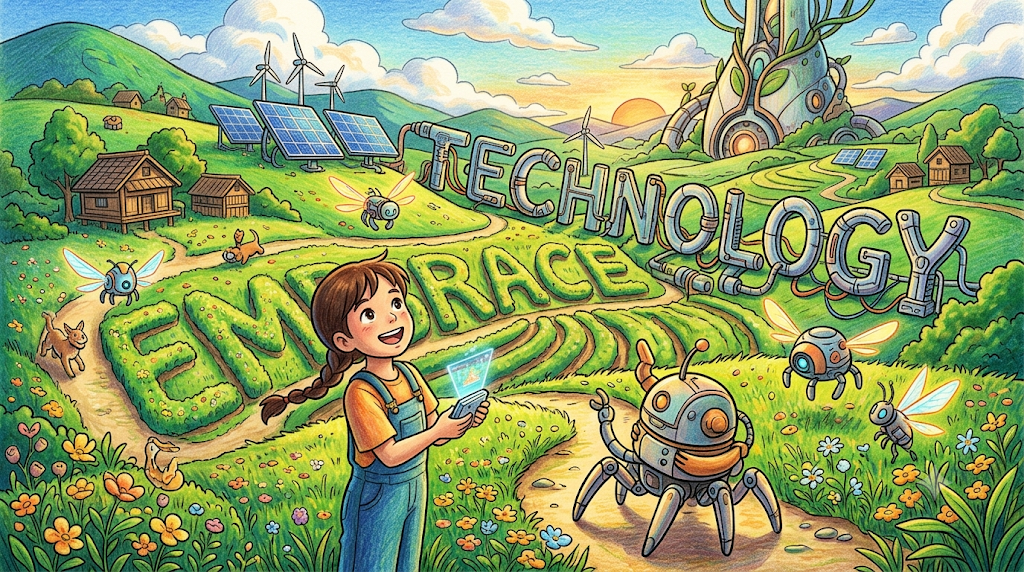
embrace technology [ɪmˈbreɪs tekˈnɒlədʒi]
품사/뉘앙스 설명
(동사구) 기술을 받아들이다, 기술 변화를 포용하다
새로운 기술이나 도구를 거부하거나 두려워하지 않고 열린 마음으로 활용하려는 것을 강조합니다. 기술을 위협이 아닌 도구로 본다는 것이 핵심 뉘앙스입니다. 수능 독해 사회·과학·교육 지문의 핵심 표현입니다.
- Teachers who embrace technology as a genuine pedagogical tool rather than a distraction to be managed find that it opens possibilities that traditional methods do not — allowing students to access primary sources directly, collaborate with peers in other countries, and receive immediate feedback on their work. (기술을 관리해야 할 방해물이 아닌 진정한 교육학적 도구로 받아들이는 선생님들은 그것이 전통적인 방법이 열지 못하는 가능성을 열어준다는 것을 발견한다 — 학생들이 직접 원자료에 접근하고, 다른 나라의 동료들과 협력하며, 작업에 대한 즉각적인 피드백을 받을 수 있도록 하는.)
- Societies that embrace technology while also actively regulating its potential harms tend to achieve better outcomes than those that either adopt it entirely uncritically or resist it almost entirely — because both extreme positions sacrifice the very real benefits that thoughtful engagement can produce. (기술을 받아들이면서 동시에 잠재적 해악을 적극적으로 규제하는 사회들은 전혀 비판 없이 채택하거나 거의 완전히 저항하는 사회들보다 더 나은 결과를 달성하는 경향이 있다 — 두 극단적인 입장 모두 사려 깊은 참여가 만들어낼 수 있는 매우 실질적인 혜택을 희생하기 때문이다.)
- Whether to embrace technology in a particular context is rarely a simple yes or no question — it requires asking what specific problem the technology is meant to solve, whether it solves that problem better than alternatives, and what new problems its introduction might create. (특정 맥락에서 기술을 받아들일지 여부는 간단한 예 또는 아니오 질문이 거의 아니다 — 기술이 어떤 특정 문제를 해결하기 위한 것인지, 대안보다 그 문제를 더 잘 해결하는지, 그리고 그 도입이 어떤 새로운 문제를 만들 수 있는지 묻는 것을 필요로 한다.)

fully embrace [ˈfʊli ɪmˈbreɪs]
품사/뉘앙스 설명
(동사구) 완전히 받아들이다, 전적으로 포용하다
어떤 것을 부분적이 아닌 완전하고 전면적으로 수용하는 것을 강조합니다. 반쪽짜리 수용과 완전한 수용의 차이가 핵심 뉘앙스입니다. 수능 독해 심리·사회·교육 지문에서 자주 등장합니다.
- Many people say they fully embrace failure as a learning opportunity but behave very differently when the failure actually happens — avoiding talking about what went wrong, blaming external factors, or avoiding similar situations in future — suggesting that the intellectual agreement and the emotional acceptance are much further apart than they appeared. (많은 사람들이 실패를 학습 기회로 완전히 받아들인다고 말하지만 실패가 실제로 일어날 때 매우 다르게 행동한다 — 무엇이 잘못됐는지에 대해 이야기하기를 피하고, 외부 요인을 탓하거나, 미래에 유사한 상황을 피하는 — 이것은 지적인 동의와 감정적인 수용이 보였던 것보다 훨씬 더 멀리 떨어져 있다는 것을 시사한다.)
- To fully embrace a new culture rather than simply observing it from a comfortable distance requires a willingness to feel awkward, to misunderstand and be misunderstood, and to accept that the process of becoming comfortable in a new way of living takes time that cannot be shortened by good intentions alone. (단순히 편안한 거리에서 관찰하기보다 새로운 문화를 완전히 받아들이기 위해서는 어색하게 느끼고, 오해하고 오해받으며, 새로운 삶의 방식에서 편안해지는 과정이 좋은 의도만으로는 단축될 수 없는 시간이 필요하다는 것을 받아들이려는 의지가 필요하다.)
- The difference between an organisation that fully embraces sustainability and one that treats it as a compliance requirement is visible not just in their environmental outcomes but in their culture — the first builds sustainability into every decision from the start, while the second adds it as an afterthought when required by regulation. (지속 가능성을 완전히 받아들이는 조직과 그것을 준수 요건으로 취급하는 조직의 차이는 환경 결과만이 아니라 문화에서도 볼 수 있다 — 첫 번째는 처음부터 모든 결정에 지속 가능성을 내재화하는 반면 두 번째는 규정에서 요구될 때 사후 생각으로 추가한다.)
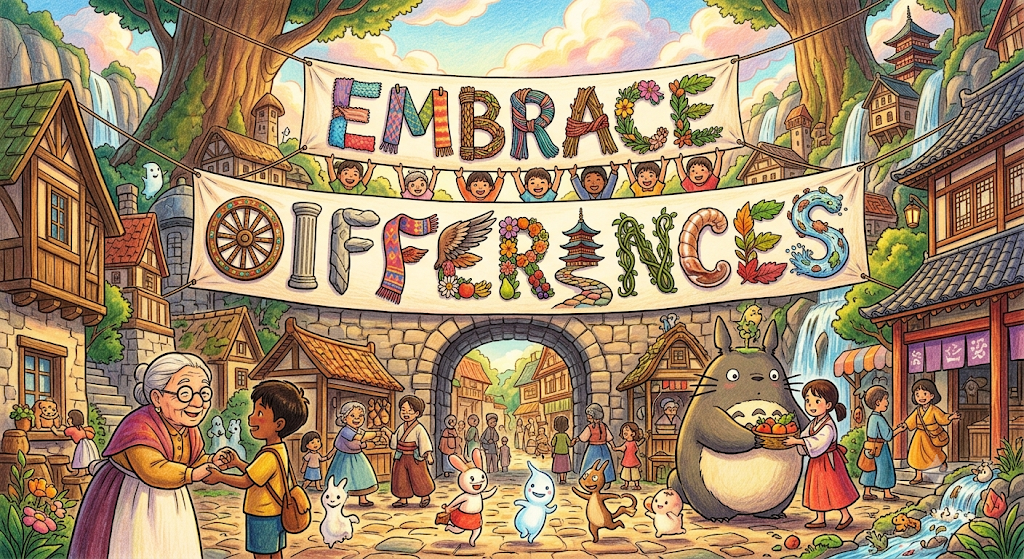
embrace differences [ɪmˈbreɪs ˈdɪfrənsɪz]
품사/뉘앙스 설명
(동사구) 차이를 포용하다, 다름을 환영하다
자신과 다른 사람들의 특성이나 관점을 문제가 아닌 가치 있는 것으로 환영하는 것을 강조합니다. 차이가 풍요로움의 원천이라는 인식이 핵심 뉘앙스입니다. 수능 독해 사회·교육·문화 지문에서 자주 등장합니다.
- Friendships that manage to embrace differences in political views, religious beliefs, or lifestyle choices require a kind of active respect that goes beyond tolerance — an ability to remain genuinely curious about how someone you care about can see the world so differently from you without needing to resolve the difference. (정치적 견해, 종교적 믿음, 또는 생활 방식 선택에서의 차이를 포용하는 데 성공하는 우정은 관용을 넘어서는 일종의 능동적 존중을 필요로 한다 — 차이를 해결할 필요 없이 당신이 아끼는 누군가가 어떻게 당신과 그렇게 다르게 세상을 볼 수 있는지에 대해 진정으로 호기심을 유지하는 능력이다.)
- Educational systems that embrace differences in how students learn — recognising that some people learn better through reading, others through discussion, others through doing — tend to produce better outcomes across the whole range of student ability than those that assume one approach works equally well for everyone. (학생들이 어떻게 배우는지의 차이를 포용하는 교육 시스템들 — 일부 사람들은 읽기를 통해, 다른 사람들은 토론을 통해, 다른 사람들은 행동을 통해 더 잘 배운다는 것을 인정하는 — 은 한 가지 접근 방식이 모든 사람에게 동등하게 효과가 있다고 가정하는 것들보다 전체 학생 능력 범위에 걸쳐 더 나은 결과를 만들어내는 경향이 있다.)
- Learning to embrace differences between generations within a family — rather than treating the gap as a problem to be overcome or minimised — opens the possibility that each generation has something genuine to teach the others and that the most functional families are those where both the young and old are learners as well as teachers. (가족 내 세대 간의 차이를 포용하는 것을 배우는 것 — 그 차이를 극복하거나 최소화해야 할 문제로 취급하기보다 — 각 세대가 다른 세대들에게 진정으로 가르칠 것이 있고 가장 기능적인 가족은 젊은이와 노인 모두 교사뿐만 아니라 학습자인 가족이라는 가능성을 열어준다.)

embrace the opportunity [ɪmˈbreɪs ðə ˌɒpəˈtjuːnɪti]
품사/뉘앙스 설명
(동사구) 기회를 받아들이다, 기회를 적극적으로 잡다
기회가 왔을 때 망설이거나 두려워하지 않고 열정적으로 잡는 것을 강조합니다. 기회를 기다리지 않고 적극적으로 활용한다는 것이 핵심 뉘앙스입니다. 수능 독해 사회·심리·교육 지문의 핵심 표현입니다.
- Not everyone who is given the chance to speak in public embraces the opportunity — many people decline, citing nervousness — but those who push through the discomfort and embrace the opportunity consistently report that the experience, though initially frightening, becomes one of the most valuable they have. (대중 앞에서 말할 기회가 주어진 모든 사람이 기회를 받아들이지는 않는다 — 많은 사람들이 긴장을 이유로 거절한다 — 하지만 불편함을 극복하고 기회를 받아들이는 사람들은 그 경험이 처음에는 무섭지만 자신이 가진 가장 가치 있는 경험 중 하나가 된다고 일관되게 보고한다.)
- The ability to embrace the opportunity in a setback — to identify what can be learned, what can be changed, and what unexpected advantage the difficult situation might create — is one of the characteristics that most reliably distinguishes people who continue to grow throughout their lives from those who plateau after a period of early success. (좌절에서 기회를 받아들이는 능력 — 배울 수 있는 것, 바꿀 수 있는 것, 그리고 어려운 상황이 만들 수 있는 예상치 못한 이점을 확인하는 것 — 은 초기 성공 후 정체되는 사람들과 평생 계속 성장하는 사람들을 가장 신뢰할 수 있게 구별하는 특성 중 하나이다.)
- Students who embrace the opportunity to work with people very different from themselves — in group projects, in extracurricular activities, or in voluntary work — often discover that their assumptions about what those people would be like were wrong in interesting ways that shift their understanding of the world. (자신과 매우 다른 사람들과 함께 일할 기회를 받아들이는 학생들 — 그룹 프로젝트에서, 과외 활동에서, 또는 자원봉사 활동에서 — 은 종종 그 사람들이 어떨 것이라는 가정이 세상에 대한 이해를 바꾸는 흥미로운 방식으로 틀렸다는 것을 발견한다.)

embrace one's identity [ɪmˈbreɪs wʌnz aɪˈdentɪti]
품사/뉘앙스 설명
(동사구) 자신의 정체성을 받아들이다, 자신을 포용하다
자신의 특성이나 배경이나 본모습을 부끄러워하거나 숨기지 않고 온전히 수용하는 것을 강조합니다. 자기 수용이 외부의 인정보다 먼저라는 것이 핵심 뉘앙스입니다. 수능 독해 심리·사회·교육 지문의 핵심 표현입니다.
- The journey to embrace one's identity is rarely straightforward — it often involves first understanding which parts of who you are come from genuine choice and which come from the pressures and expectations of others, and then deciding which of those you want to keep and which you want to shed. (자신의 정체성을 받아들이는 여정은 거의 간단하지 않다 — 그것은 종종 먼저 자신의 어떤 부분이 진정한 선택에서 오고 어떤 부분이 다른 사람들의 압박과 기대에서 오는지 이해하고 그런 다음 어떤 것을 유지하고 어떤 것을 버리고 싶은지 결정하는 것을 포함한다.)
- Encouraging students to embrace their identity does not mean telling them that everything about how they currently are is perfect and should not change — it means helping them develop the security to choose which changes to make from a place of self-respect rather than self-rejection. (학생들이 자신의 정체성을 받아들이도록 장려하는 것은 그들의 현재 모습에 관한 모든 것이 완벽하고 변해서는 안 된다고 말하는 것을 의미하지 않는다 — 그것은 그들이 자기 거부가 아닌 자기 존중의 자리에서 어떤 변화를 만들지 선택할 안정감을 개발하도록 돕는 것을 의미한다.)
- Communities in which members are helped to embrace their identity while also remaining genuinely open to the identities of others tend to produce individuals with stronger senses of self and greater capacity for genuine connection across difference than communities where either conformity or separation is the norm. (구성원들이 다른 사람들의 정체성에 진정으로 열린 상태를 유지하면서 자신의 정체성을 받아들이도록 도움받는 지역 사회는 순응이나 분리가 규범인 지역 사회보다 더 강한 자아감과 차이를 넘어서는 진정한 연결을 위한 더 큰 능력을 가진 개인들을 만들어내는 경향이 있다.)
숙어 그룹 묶음 1 — 변화와 도전 수용 embrace 핵심 패턴
표현 의미 핵심 뉘앙스 주요 맥락
| embrace change | 변화를 포용하다 | 변화가 위협이 아닌 기회로 보이는 것 | 사회·심리·교육 |
| embrace challenges | 도전을 받아들이다 | 도전이 위협이 아닌 성장의 원천인 것 | 심리·교육·사회 |
| embrace the opportunity | 기회를 받아들이다 | 기회를 기다리지 않고 적극적으로 활용하는 것 | 사회·심리·교육 |
이 세 표현은 모두 embrace의 "두려워하거나 거부하지 않고 열린 마음으로 환영하는" 이미지를 공유하되, 각각 새로운 상황의 환영(embrace change)·어려운 상황의 수용(embrace challenges)·기회의 적극적 포착(embrace the opportunity)의 관점에서 접근합니다.
- People who embrace change are also usually better at embracing challenges and more likely to embrace opportunities when they arise — because all three require the same fundamental willingness to engage with uncertainty rather than retreating from it, and the habit of openness in one area tends to reinforce itself in the others. (변화를 포용하는 사람들은 또한 보통 도전을 받아들이는 데 더 뛰어나고 기회가 생겼을 때 받아들일 가능성이 더 높다 — 세 가지 모두 불확실성에서 물러나는 것이 아닌 참여하려는 동일한 근본적인 의지를 필요로 하기 때문이고 한 영역에서의 개방성 습관은 다른 영역에서도 스스로 강화되는 경향이 있기 때문이다.)
- Teaching young people to embrace challenges rather than avoid them is one of the most effective ways to prepare them to embrace change in later life and to embrace the opportunities that change creates — because the muscle of engaging with difficulty, once developed, can be applied to almost any situation that requires adaptation. (젊은 사람들에게 어려움을 피하기보다 도전을 받아들이도록 가르치는 것은 나중 삶에서 변화를 포용하고 변화가 만들어내는 기회를 받아들이도록 준비시키는 가장 효과적인 방법 중 하나이다 — 어려움과 참여하는 근육이 일단 개발되면 적응이 필요한 거의 모든 상황에 적용될 수 있기 때문이다.)
- Organisations that embrace the opportunity to reinvent themselves when markets change, that embrace challenges as design problems rather than threats, and that embrace change as a continuous process rather than an occasional disruption tend to outperform those that treat stability as the ideal condition and novelty as something to be managed into the smallest possible footprint. (시장이 변할 때 자신을 재창조할 기회를 받아들이고, 도전을 위협이 아닌 설계 문제로 받아들이며, 변화를 가끔의 혼란이 아닌 지속적인 과정으로 포용하는 조직들은 안정성을 이상적인 조건으로 취급하고 참신함을 가능한 가장 작은 발자국으로 관리해야 할 것으로 취급하는 조직들보다 뛰어난 성과를 내는 경향이 있다.)
숙어 그룹 묶음 2 — 다양성과 차이 포용 embrace 심화 패턴
표현 의미 핵심 뉘앙스 주요 맥락
| embrace diversity | 다양성을 포용하다 | 다양성이 가치 있다는 인식 | 사회·교육·문화 |
| embrace differences | 차이를 포용하다 | 차이가 풍요로움의 원천이라는 인식 | 사회·교육·문화 |
| warmly embrace | 따뜻하게 받아들이다 | 온기와 진정성이 있는 수용 | 사회·문학·교육 |
이 세 표현은 모두 embrace의 "다름을 열린 마음으로 환영하는" 이미지를 공유하되, 각각 집단적 다양성의 가치(embrace diversity)·개인 간 차이의 포용(embrace differences)·진심 어린 온기로 환영하는 것(warmly embrace)의 관점에서 접근합니다.
- Schools that warmly embrace new students from different backgrounds, that actively embrace diversity in their curriculum and staffing, and that teach students how to embrace differences in one another create environments that prepare young people not just for academic success but for the genuinely diverse world they will live and work in. (다른 배경의 새 학생들을 따뜻하게 환영하고, 커리큘럼과 직원에서 적극적으로 다양성을 포용하며, 학생들에게 서로의 차이를 포용하는 방법을 가르치는 학교들은 젊은 사람들을 학업적 성공만이 아니라 살아가고 일할 진정으로 다양한 세상을 위해 준비시키는 환경을 만든다.)
- Warmly embracing the people who are most different from us requires first embracing the differences that make connection more complicated, and then discovering that diversity in perspective and experience is not just something to be tolerated but something that actually makes the relationship more valuable, more interesting, and more durable over time. (우리와 가장 다른 사람들을 따뜻하게 받아들이기 위해서는 먼저 연결을 더 복잡하게 만드는 차이를 포용하고, 그런 다음 관점과 경험의 다양성이 단순히 용인되어야 할 것이 아니라 실제로 관계를 더 가치 있고, 더 흥미롭고, 시간이 지나면서 더 지속 가능하게 만드는 것이라는 것을 발견하는 것을 필요로 한다.)
- The difference between an organisation that warmly embraces diversity and one that merely tolerates it is measurable — in the first, people from different backgrounds embrace differences as a creative resource and produce ideas that would not exist in a more homogeneous setting; in the second, surface-level diversity coexists with an underlying pressure to conform that prevents anyone from fully contributing what makes them distinctive. (다양성을 따뜻하게 포용하는 조직과 단순히 그것을 용인하는 조직의 차이는 측정 가능하다 — 첫 번째에서는 다른 배경을 가진 사람들이 차이를 창의적 자원으로 포용하고 더 동질적인 환경에서는 존재하지 않을 아이디어를 만들어낸다; 두 번째에서는 표면적 다양성이 아무도 자신을 독특하게 만드는 것을 완전히 기여하지 못하게 막는 순응의 근본적인 압박과 공존한다.)
숙어 그룹 묶음 3 — 아이디어와 기술 수용 embrace 심화 패턴
표현 의미 핵심 뉘앙스 주요 맥락
| embrace the idea of | ~라는 아이디어를 받아들이다 | 아이디어가 초기에는 저항받을 수 있는 것 | 교육·사회·과학 |
| embrace technology | 기술을 받아들이다 | 기술을 위협이 아닌 도구로 보는 것 | 사회·과학·교육 |
| fully embrace | 완전히 받아들이다 | 반쪽짜리 수용과 완전한 수용의 차이 | 심리·사회·교육 |
이 세 표현은 모두 embrace의 "새로운 것을 열정적으로 수용하는" 이미지를 공유하되, 각각 특정 개념이나 생각의 수용(embrace the idea of)·새로운 도구와 방법의 수용(embrace technology)·수용의 완전성과 전면성(fully embrace)의 관점에서 접근합니다.
- Fully embracing technology requires first embracing the idea of using tools that change how you work, which is harder than it sounds — because embracing a new tool fully means accepting that some established practices may need to be abandoned, and that the discomfort of learning something new is a necessary cost of access to its benefits. (기술을 완전히 받아들이기 위해서는 먼저 작업 방식을 바꾸는 도구를 사용한다는 아이디어를 받아들이는 것이 필요한데 이것은 들리는 것보다 더 어렵다 — 새로운 도구를 완전히 받아들이는 것은 일부 확립된 관행이 포기될 필요가 있을 수 있다는 것과 새로운 것을 배우는 불편함이 그 혜택에 접근하는 데 필요한 비용이라는 것을 받아들이는 것을 의미하기 때문이다.)
- Scientists who fully embrace the idea of paradigm shifts — that sometimes the entire framework for understanding a field must be replaced rather than refined — are able to make the most of new evidence that does not fit existing theories rather than distorting or minimising it to protect what they already believe. (패러다임 전환이라는 아이디어를 완전히 받아들이는 과학자들 — 때로 분야를 이해하기 위한 전체 틀이 정제되기보다 대체되어야 한다는 — 은 이미 믿는 것을 보호하기 위해 그것을 왜곡하거나 최소화하기보다 기존 이론에 맞지 않는 새로운 증거를 최대한 활용할 수 있다.)
- Communities that fully embrace technology as a means of solving social problems — rather than treating it as a supplement to established ways of doing things — and that simultaneously embrace the idea of redesigning services around what people actually need rather than what existing systems can easily provide, tend to produce improvements that incremental approaches cannot. (기술을 기존 방식의 보충으로 취급하기보다 사회 문제를 해결하는 수단으로 완전히 받아들이고 — 동시에 기존 시스템이 쉽게 제공할 수 있는 것이 아닌 사람들이 실제로 필요로 하는 것을 중심으로 서비스를 재설계한다는 아이디어를 받아들이는 — 지역 사회들은 점진적인 접근 방식이 할 수 없는 개선을 만들어내는 경향이 있다.)
숙어 그룹 묶음 4 — 정체성과 완성 embrace 완성 패턴
표현 의미 핵심 뉘앙스 주요 맥락
| embrace one's identity | 자신의 정체성을 받아들이다 | 자기 수용이 외부의 인정보다 먼저라는 것 | 심리·사회·교육 |
| fully embrace | 완전히 받아들이다 | 반쪽짜리 수용과 완전한 수용의 차이 | 심리·사회·교육 |
| embrace differences | 차이를 포용하다 | 차이가 풍요로움의 원천이라는 인식 | 사회·교육·문화 |
이 세 표현은 함께 embrace가 나타내는 자기·타자·차이의 스펙트럼을 보여줍니다. embrace one's identity는 자기 자신에 대한 수용을, fully embrace는 수용의 완전성을, embrace differences는 타인과의 차이에 대한 수용을 각각 강조합니다.
- People who have fully embraced their own identity — including the parts that make them different from those around them — are usually also better at embracing the differences of others, because genuine self-acceptance tends to reduce the anxiety that makes people feel threatened by those who are unlike them. (자신의 정체성을 완전히 받아들인 사람들 — 주변 사람들과 다르게 만드는 부분들을 포함하여 — 은 보통 타인의 차이를 받아들이는 데도 더 뛰어난데 진정한 자기 수용이 자신과 다른 사람들에 의해 위협받는다고 느끼게 만드는 불안을 줄이는 경향이 있기 때문이다.)
- The process of learning to embrace one's identity fully — rather than performing a version of it that one thinks will be more acceptable to others — often involves first recognising how much energy is spent managing others' perceptions and then deciding that the freedom gained by fully embracing who you actually are is worth the discomfort of being seen more completely. (자신의 정체성을 완전히 받아들이는 것을 배우는 과정 — 다른 사람들에게 더 받아들여질 것이라고 생각하는 버전을 수행하는 것이 아닌 — 은 종종 먼저 얼마나 많은 에너지가 다른 사람들의 인식을 관리하는 데 소비되는지 인식하고 그런 다음 실제로 당신이 누구인지를 완전히 받아들임으로써 얻는 자유가 더 완전하게 보이는 불편함을 감수할 가치가 있다고 결정하는 것을 포함한다.)
- Communities that help their members embrace differences while also supporting each individual in fully embracing their own identity create the conditions for the kind of genuine connection across difference that is only possible when people feel secure enough in who they are to be genuinely curious about who others are, rather than measuring others against themselves as a standard. (차이를 포용하도록 구성원을 돕는 동시에 각 개인이 자신의 정체성을 완전히 받아들이도록 지원하는 지역 사회는 사람들이 기준으로 자신을 다른 사람들과 비교하는 것이 아닌 자신이 누구인지에 대해 충분히 안전하게 느끼며 다른 사람들이 누구인지에 대해 진정으로 호기심을 가질 수 있을 때만 가능한 차이를 넘어서는 진정한 연결의 조건을 만든다.)
전체 요약표
표현 의미 핵심 뉘앙스
| embrace | 껴안다, 포용하다, 받아들이다 / 포옹, 포용 | 열린 팔로 기꺼이 맞이하는 이미지 |
| embrace change | 변화를 포용하다 | 변화가 위협이 아닌 기회로 보이는 것 |
| embrace diversity | 다양성을 포용하다 | 다양성이 가치 있다는 인식 |
| embrace the idea of | ~라는 아이디어를 받아들이다 | 아이디어가 초기에는 저항받을 수 있는 것 |
| warmly embrace | 따뜻하게 받아들이다 | 온기와 진정성이 있는 수용 |
| embrace challenges | 도전을 받아들이다 | 도전이 위협이 아닌 성장의 원천인 것 |
| embrace technology | 기술을 받아들이다 | 기술을 위협이 아닌 도구로 보는 것 |
| fully embrace | 완전히 받아들이다 | 반쪽짜리 수용과 완전한 수용의 차이 |
| embrace differences | 차이를 포용하다 | 차이가 풍요로움의 원천이라는 인식 |
| embrace the opportunity | 기회를 받아들이다 | 기회를 기다리지 않고 적극적으로 활용하는 것 |
| embrace one's identity | 자신의 정체성을 받아들이다 | 자기 수용이 외부의 인정보다 먼저라는 것 |
유의어 비교표
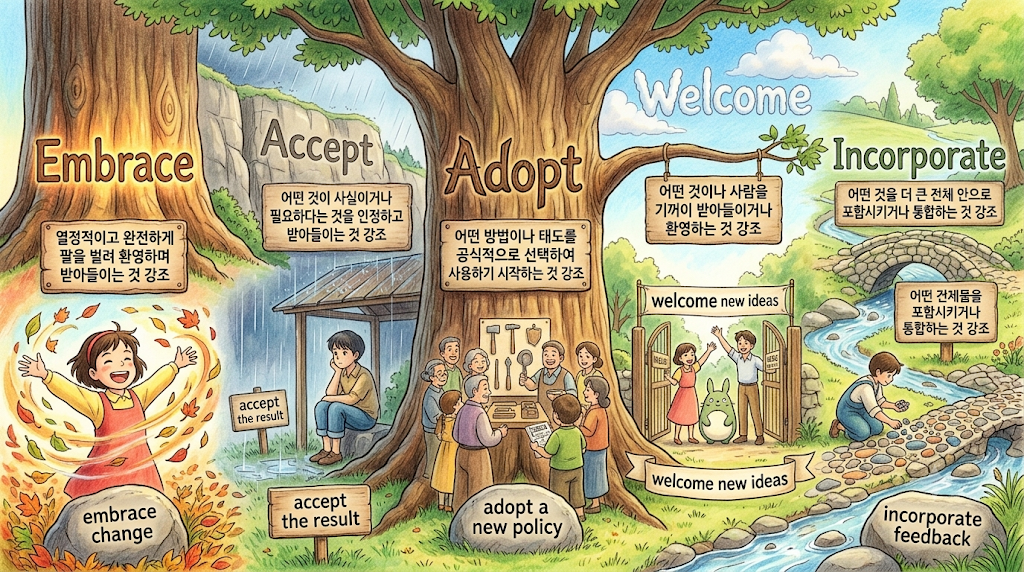
단어 공통점 뉘앙스 차이 예문
| embrace | 수용 관련 | 열정적이고 완전하게 팔을 벌려 환영하며 받아들이는 것 강조 | embrace change |
| accept | 수용 관련 | 어떤 것이 사실이거나 필요하다는 것을 인정하고 받아들이는 것 강조 | accept the result |
| adopt | 수용 관련 | 어떤 방법이나 태도를 공식적으로 선택하여 사용하기 시작하는 것 강조 | adopt a policy |
| welcome | 수용 관련 | 어떤 것이나 사람을 기꺼이 받아들이거나 환영하는 것 강조 | welcome new ideas |
| incorporate | 수용 관련 | 어떤 것을 더 큰 전체 안으로 포함시키거나 통합하는 것 강조 | incorporate feedback |
결론 정리
embrace는 단순히 "껴안다"가 아니라, 팔을 벌려 환영하며 껴안듯이 어떤 것을 거부하거나 밀어내지 않고 열정적이고 완전하게 가슴으로 받아들이는 이미지에서 출발해 변화를 포용하다·다양성을 포용하다·~라는 아이디어를 받아들이다·따뜻하게 받아들이다·도전을 받아들이다·기술을 받아들이다·완전히 받아들이다·차이를 포용하다·기회를 받아들이다·자신의 정체성을 받아들이다까지 확장되는 단어다 — embrace가 있는 곳엔 언제나 '팔을 벌려 환영하며 안듯이 두려워하거나 거부하지 않고 열정적으로 가슴으로 받아들이는' 포용과 환영의 이미지가 있다.
💡 embrace는 "팔을 벌려 환영하며 껴안듯이 어떤 것을 열정적이고 완전하게 기꺼이 받아들이는 것을 가리키는" 단어 — embrace change·fully embrace·embrace diversity 가 수능 최빈출. accept(인정하는 수용)·adopt(공식적 도입)와의 구별이 핵심 출제 포인트.
🌟 초등학생 버전 embrace는 단순히 "껴안다"가 아니에요! embrace change는 새 학기에 새 반이 됐을 때 불안해하거나 싫다고 하지 않고 "좋아, 새 친구들을 사귀자!"라고 팔을 벌려 기쁘게 맞이하는 것처럼 새로운 상황을 두려워하거나 거부하지 않고 열린 마음으로 기꺼이 환영하는 것이고, embrace differences는 나와 취미가 전혀 다른 친구를 "너 정말 신기하고 재밌는 것 좋아하네, 나도 배워볼게!"라고 반기는 것처럼 자신과 다른 점을 문제로 보지 않고 오히려 흥미롭고 가치 있는 것으로 환영하는 것이에요! 🌍✨


