
- 분류 전체보기 (5746)

| 일 | 월 | 화 | 수 | 목 | 금 | 토 |
|---|---|---|---|---|---|---|
| 1 | 2 | 3 | ||||
| 4 | 5 | 6 | 7 | 8 | 9 | 10 |
| 11 | 12 | 13 | 14 | 15 | 16 | 17 |
| 18 | 19 | 20 | 21 | 22 | 23 | 24 |
| 25 | 26 | 27 | 28 | 29 | 30 | 31 |
- Show Up
- Sorry
- I'm sorry
- hold on
- please.
- Sure
- Actually
- Read between the lines
- no
- get through
- Don't worry
- pick up
- Excuse me
- well
- Yes
- Right?
- I'm glad to hear that.
- oh
- please?
- too.
- entrance fee
- work out
- make it
- Hey
- Please
- come up with
- OKay
- set up
- By The Way
- Yeah
- Today
- Total
인과함께
Day448 , barrier, barrier to, break down barriers, language barrier, trade barrier, overcome a barrier, barrier between, cultural barrier, raise a barrier, barrier free, act as a barrier 본문
Day448 , barrier, barrier to, break down barriers, language barrier, trade barrier, overcome a barrier, barrier between, cultural barrier, raise a barrier, barrier free, act as a barrier
미인생 2026. 10. 27. 11:19
barrier [ˈbæriər]
(명사) 장벽, 장애물, 방해물
Fear of making mistakes can be a big barrier to learning English.
(실수하는 것에 대한 두려움은 영어 학습에 큰 장벽이 될 수 있다.)
단순히 "장벽"으로만 외우면 수능에서 반드시 틀립니다. barrier는 "단순히 앞을 막고 있는 물리적인 벽이 아니라, 어떤 것이 일어나거나 사람이 나아가거나 둘 사이의 연결이 이루어지는 것을 방해하는 모든 종류의 장애물 — 눈에 보이는 울타리일 수도 있고, 언어의 차이·경제적 격차·문화적 차이·심리적 두려움처럼 눈에 보이지 않는 것일 수도 있으며, 그 장벽이 있는 한 어떤 것도 쉽게 그 경계를 넘지 못하게 되는 것" 이라는 핵심 이미지에서 출발해, 물리적 장벽에서 언어 장벽·무역 장벽·문화 장벽·심리적 장벽·사회적 장벽까지 폭넓게 쓰이는 핵심 다의어입니다. 특히 barrier(어떤 것의 흐름이나 이동이나 연결을 막는 것) vs. obstacle(앞길을 막는 구체적인 어려움) vs. hindrance(방해하고 늦추는 것) 의 뉘앙스 차이, barrier to(~에 대한 장벽), break down barriers(장벽을 허물다) 패턴은 수능 독해 사회·경제·교육·심리·역사·과학 지문에서 핵심적으로 등장합니다.
'barrier'는 고대 프랑스어 barriere(울타리, 막대기로 막은 것)에서 유래했습니다. barre(막대기, 가로막는 것)에서 파생되어, 원래 "막대기나 울타리로 만든 물리적인 경계" 를 뜻했습니다. barrier의 핵심 이미지는 "막대기를 가로질러 놓아 아무것도 그 선을 넘지 못하게 하는 것처럼 — 사람이든, 물건이든, 생각이든, 기회든, 어떤 것이 한쪽에서 다른 쪽으로 자유롭게 이동하거나 연결되는 것을 막는 경계선이나 방해물" 로, 이 이미지에서 물리적 경계·언어 장벽·무역 장벽·문화 장벽·심리적 장벽이 모두 확장되었습니다.
💡 barrier의 핵심 뉘앙스
"막대기를 가로질러 흐름을 막는 경계, barrier."
1️⃣ 기본 뜻: 장벽·장애물·방해물
- barrier → 명사로 "장벽, 장애물, 방해물" — 고대 프랑스어 barriere(울타리, 막대기로 막은 것)와 barre(막대기)에서 유래, 막대기를 가로질러 놓아 아무것도 그 선을 넘지 못하게 하듯 사람이든 물건이든 생각이든 기회든 한쪽에서 다른 쪽으로 자유롭게 이동하거나 연결되는 것을 막는 경계선이라는 이미지가 핵심이다. 눈에 보이는 울타리일 수도 있고 언어·경제·문화·두려움처럼 보이지 않는 것일 수도 있다.
- barrier vs. obstacle vs. hindrance → barrier는 흐름이나 연결 자체를 막는 구조적이고 지속적인 경계, obstacle은 앞길을 막는 구체적이고 개별적인 어려움, hindrance는 완전히 막지는 않지만 방해하고 늦추는 것 — 수능 최빈출 구별 포인트.
2️⃣ 사람 사이의 장벽 핵심 세트
- language barrier → 언어 장벽. "The language barrier is not simply a communication problem but a social and economic one." — 수능 최빈출.
- cultural barrier → 문화 장벽. "Cultural barriers are often invisible to those who create them."
- barrier between → ~ 사이의 장벽. "The barrier between professional and personal life has been eroded by digital communication."
3️⃣ 접근을 막는 구조적 장벽 핵심 세트
- barrier to → ~에 대한 장벽. "The cost of higher education has become a significant barrier to social mobility." — 수능 최빈출.
- trade barrier → 무역 장벽. "The reduction of trade barriers drove global economic integration, but gains were unevenly distributed."
- raise a barrier → 장벽을 세우다. "Licensing requirements raise barriers to entry in professional services."
4️⃣ 장벽에 대한 대응과 기능 핵심 세트
- break down barriers → 장벽을 허물다. "Shared activities like team sports break down barriers between strangers." — 수능 최빈출.
- overcome a barrier → 장벽을 극복하다. "Stigma and cost are barriers that people must overcome to seek mental health support."
- barrier free → 장벽 없는. "Barrier free design benefits not just people with disabilities but the general population."
- act as a barrier → 장벽 역할을 하다. "The skin acts as the body's primary barrier against the external environment." — 수능 최빈출.
💡 아들에게 이렇게 설명해보세요
"barrier는 '장벽'인데 핵심은 길 위에 막대기를 가로질러 놓은 것처럼 어떤 것이 한쪽에서 다른 쪽으로 자유롭게 넘어가지 못하게 막는 경계선이야. 눈에 보이는 울타리일 수도 있고 보이지 않는 것일 수도 있어. 먼저 사람 사이의 장벽부터 보자. language barrier는 서로 다른 말을 쓰기 때문에 소통이 막히는 '언어 장벽'이고, cultural barrier는 문화가 달라서 같은 말도 다르게 받아들이는 '문화 장벽'인데 만드는 사람은 모르는 경우가 많아. barrier between은 두 사람이나 두 집단 '사이의 장벽'이야. 다음은 구조적인 장벽이야. barrier to는 '~에 대한 장벽'이라서 대학 등록금이 학업의 장벽이 되는 것처럼 개인의 노력만으로는 넘기 어려울 때 써. trade barrier는 나라 사이의 상품 이동을 막는 '무역 장벽', raise a barrier는 일부러 '장벽을 세우는' 거야. 마지막은 대응이야. break down barriers는 함께 운동하다가 서로 친해지는 것처럼 '장벽을 허무는' 거고, overcome a barrier는 막힌 걸 이겨내고 '장벽을 극복하는' 거야. barrier free는 휠체어도 편하게 다니는 '장벽 없는' 환경이고, act as a barrier는 피부가 몸을 지켜주듯 '장벽 역할을 하는' 거야. barrier는 obstacle(길을 막은 구체적인 방해물 하나)이나 hindrance(막지는 못하고 늦추는 것)랑 다르게 '흐름이나 연결 자체를 막는 구조적 경계'가 핵심이라는 걸 기억해! 파생어로 bar(막대기, 막다), barricade(바리케이드), embargo(무역 금지)도 같이 알아두면 좋아."
최종 한 줄 요약: 막대기를 가로질러 놓아 아무것도 그 선을 넘지 못하게 하는 경계의 이미지에서 출발해 언어·문화·사람 사이의 장벽, 접근과 무역과 진입을 막는 구조적 장벽, 장벽을 허물고 극복하고 없애는 행동, 보호와 차단 두 기능까지 확장되는 흐름과 연결을 막는 경계의 언어.
1. barrier to [ˈbæriər tuː]
(사회/교육/수능) "~에 대한 장벽, ~을 가로막는 장애물"을 뜻합니다. 어떤 것을 달성하거나 접근하거나 이루는 것을 방해하는 장애물을 강조합니다. 수능 독해 사회·교육·경제 지문의 핵심 표현입니다.
The cost of higher education has become one of the most significant barriers to social mobility in many countries — when the financial investment required to obtain a degree exceeds what families without accumulated wealth can absorb, the credential that most reliably improves life outcomes becomes available primarily to those who need it least. (고등 교육 비용은 많은 나라에서 사회적 이동성에 대한 가장 중요한 장벽 중 하나가 됐다 — 학위를 얻는 데 필요한 재정 투자가 축적된 부 없이는 가족들이 감당할 수 있는 것을 초과할 때 삶의 결과를 가장 확실하게 향상시키는 자격증이 주로 가장 필요로 하지 않는 사람들에게 이용 가능해진다.)
2. break down barriers [breɪk daʊn ˈbæriərz]
(사회/교육/수능) "장벽을 허물다, 장애물을 제거하다"를 뜻합니다. 사람들 사이의 이해·소통·협력을 가로막던 장벽을 제거하는 것을 강조합니다. 수능 독해 사회·교육·심리 지문의 핵심 표현입니다.
Shared creative and athletic activities — choral singing, team sports, community theatre, and collective artistic projects — are particularly effective at breaking down barriers between people who would otherwise remain strangers, because they create conditions of equal status, shared purpose, and coordinated effort that bypass the social categories that normally keep people apart. (합창, 팀 스포츠, 지역 사회 연극, 그리고 집단 예술 프로젝트와 같은 공유된 창의적이고 운동적인 활동들은 그렇지 않으면 낯선 사람으로 남을 사람들 사이의 장벽을 허무는 데 특히 효과적인데 그것들이 사람들을 보통 분리하는 사회적 범주를 우회하는 동등한 지위, 공유된 목적, 그리고 조정된 노력의 조건을 만들기 때문이다.)
3. language barrier [ˈlæŋɡwɪdʒ ˈbæriər]
(사회/교육/수능) "언어 장벽"을 뜻합니다. 서로 다른 언어를 사용하는 사람들 사이에서 소통과 이해를 방해하는 장애물을 강조합니다. 수능 독해 사회·교육·심리 지문의 핵심 표현입니다.
The language barrier that immigrants face is not simply a communication problem but a social and economic one — proficiency in the dominant language determines access to employment, healthcare, education, and civic participation, making linguistic integration one of the most consequential dimensions of the migration experience. (이민자들이 직면하는 언어 장벽은 단순히 소통의 문제가 아니라 사회적이고 경제적인 문제이다 — 지배적인 언어에서의 능숙함이 취업, 의료, 교육, 그리고 시민 참여에 대한 접근을 결정하여 언어적 통합을 이주 경험의 가장 중요한 차원 중 하나로 만든다.)
4. trade barrier [treɪd ˈbæriər]
(경제/사회/수능) "무역 장벽"을 뜻합니다. 국가 간의 상품이나 서비스의 자유로운 이동을 제한하는 관세·규제·할당제 등을 강조합니다. 수능 독해 경제·사회·역사 지문의 핵심 표현입니다.
The reduction of trade barriers through multilateral agreements has been one of the most significant drivers of global economic integration since the Second World War, but the gains from trade liberalisation have been unevenly distributed — benefiting consumers through lower prices and exporters through new markets while creating concentrated losses for workers in industries exposed to import competition. (다자간 협정을 통한 무역 장벽 축소는 제2차 세계대전 이후 글로벌 경제 통합의 가장 중요한 동인 중 하나였지만 무역 자유화로부터의 이익이 불균등하게 분배됐다 — 더 낮은 가격을 통해 소비자들에게 그리고 새로운 시장을 통해 수출업자들에게 혜택을 주는 반면 수입 경쟁에 노출된 산업의 노동자들에게 집중된 손실을 만들어냈다.)
5. overcome a barrier [ˌəʊvəˈkʌm ə ˈbæriər]
(사회/심리/수능) "장벽을 극복하다, 장애물을 넘어서다"를 뜻합니다. 앞을 막고 있는 장벽이나 어려움을 이겨내고 나아가는 것을 강조합니다. 수능 독해 사회·심리·교육 지문에서 자주 등장합니다.
The barriers that prevent people from seeking mental health support — stigma, cost, uncertainty about what treatment involves, and reluctance to acknowledge vulnerability — are frequently more significant than the practical difficulty of accessing services, which is why public health campaigns aimed at reducing barriers to treatment focus heavily on normalising help-seeking behaviour. (사람들이 정신 건강 지원을 구하는 것을 막는 장벽들 — 낙인, 비용, 치료가 무엇을 포함하는지에 대한 불확실성, 그리고 취약성을 인정하기를 꺼리는 것 — 은 전형적으로 서비스 접근의 실질적인 어려움보다 더 중요하며 이것이 왜 치료 장벽 감소를 목표로 하는 공중 보건 캠페인이 도움 구하는 행동을 정상화하는 것에 크게 집중하는 이유이다.)
6. barrier between [ˈbæriər bɪˈtwiːn]
(사회/심리/수능) "~ 사이의 장벽"을 뜻합니다. 두 사람이나 두 집단이나 두 상태 사이를 가로막고 있는 장애물을 강조합니다. 수능 독해 사회·심리·역사 지문에서 자주 등장합니다.
The barrier between professional and personal life that many workers historically maintained — the ability to leave work at work and be fully present at home — has been significantly eroded by digital communication technologies that create an expectation of continuous availability and make it technically possible for employers to reach employees at any hour. (많은 노동자들이 역사적으로 유지했던 직업 생활과 개인 생활 사이의 장벽 — 일은 직장에 남겨두고 가정에서는 완전히 현재에 있는 능력 — 은 지속적인 이용 가능성의 기대를 만들고 고용주가 어느 시간에도 직원에게 연락하는 것을 기술적으로 가능하게 하는 디지털 통신 기술에 의해 상당히 침식됐다.)
7. cultural barrier [ˈkʌltʃərəl ˈbæriər]
(사회/교육/수능) "문화 장벽"을 뜻합니다. 서로 다른 문화적 배경이나 가치관·관습의 차이로 인해 이해와 소통을 방해하는 장애물을 강조합니다. 수능 독해 사회·교육·역사 지문에서 자주 등장합니다.
Cultural barriers to effective communication are often invisible to those who create them — the assumptions about directness, formality, appropriate emotional expression, and the role of silence that feel natural within one culture can seem rude, cold, evasive, or disrespectful within another, producing misunderstandings that neither party intended. (효과적인 소통에 대한 문화적 장벽들은 종종 그것들을 만드는 사람들에게 보이지 않는다 — 한 문화 내에서 자연스럽게 느껴지는 직접성, 형식성, 적절한 감정 표현, 그리고 침묵의 역할에 대한 가정들이 다른 문화 내에서는 무례하고, 차갑고, 회피적이거나 무례하게 보일 수 있어 어느 쪽도 의도하지 않은 오해를 만들어낸다.)
8. raise a barrier [reɪz ə ˈbæriər]
(사회/경제/수능) "장벽을 세우다, 장애물을 만들다"를 뜻합니다. 어떤 것의 흐름이나 접근이나 연결을 방해하는 장벽을 의도적으로 만들거나 높이는 것을 강조합니다. 수능 독해 사회·경제·역사 지문에서 자주 등장합니다.
Licensing requirements that raise barriers to entry in professional services — by requiring extensive training, examinations, and fees before practitioners can legally operate — protect consumers from unqualified providers but also reduce competition, raise prices, and limit access, particularly for lower-income populations who most depend on affordable professional advice. (전문 서비스에서 진입 장벽을 세우는 면허 요건들 — 실무자들이 합법적으로 운영하기 전에 광범위한 훈련, 시험, 그리고 수수료를 요구함으로써 — 은 소비자들을 자격 없는 제공자로부터 보호하지만 또한 경쟁을 줄이고, 가격을 높이며, 특히 저렴한 전문적 조언에 가장 의존하는 저소득 인구의 접근을 제한한다.)
9. barrier free [ˈbæriər friː]
(사회/교육/수능) "장벽 없는, 무장애의"를 뜻합니다. 장애인이나 노약자 등이 물리적·사회적 장벽 없이 자유롭게 접근하거나 이용할 수 있는 환경을 강조합니다. 수능 독해 사회·교육·복지 지문에서 자주 등장합니다.
The movement toward barrier free urban environments — wheelchair-accessible buildings, audible pedestrian signals, tactile paving, and level public transport boarding — reflects a shift in how disability is understood, from a medical model that locates the problem in individuals to a social model that locates it in the built environment that fails to accommodate the full range of human capability. (장벽 없는 도시 환경을 향한 움직임 — 휠체어 접근 가능한 건물, 청각적 보행자 신호, 점자 포장, 그리고 평평한 대중교통 승하차 — 은 장애가 이해되는 방식의 변화를 반영하는데 문제를 개인에게 위치시키는 의료적 모델에서 인간 능력의 전체 범위를 수용하지 못하는 건축 환경에 위치시키는 사회적 모델로의 이동이다.)
10. act as a barrier [ækt æz ə ˈbæriər]
(과학/사회/수능) "장벽 역할을 하다, 방어막 구실을 하다"를 뜻합니다. 어떤 것이 다른 것의 이동이나 접근이나 전파를 막는 역할을 하는 것을 강조합니다. 수능 독해 과학·사회·환경 지문에서 자주 등장합니다.
Mountain ranges act as barriers to the movement of both weather systems and human populations, creating dramatically different climates on windward and leeward slopes and historically shaping patterns of cultural and linguistic difference as populations adapted to distinct environments on either side. (산맥은 기상 시스템과 인간 집단 모두의 이동에 대한 장벽 역할을 하며 바람받이와 바람그늘 경사면에서 극적으로 다른 기후를 만들어내고 역사적으로 어느 쪽의 뚜렷한 환경에 적응한 인구들로서 문화적이고 언어적 차이의 패턴을 형성했다.)
대한민국 입시 및 학술 주요 POINT
POINT 1. barrier vs. obstacle vs. hindrance — 수능 최빈출 뉘앙스 구별
세 단어 모두 "방해하는 것"과 관련되지만 뉘앙스가 결정적으로 다릅니다. barrier → 어떤 것의 흐름이나 이동이나 연결이 이루어지는 것을 막는 경계선이나 구조적 장애물, 제도적·구조적·사회적 성격이 강함 (구조적 차단·경계선 역할·흐름 자체를 막음 강조) obstacle → 앞길을 막고 있어서 넘어서거나 피해야 하는 구체적이고 특정한 어려움 (개별적·구체적·특정 상황의 방해물 강조) hindrance → 어떤 것을 완전히 막지는 않지만 방해하고 늦추는 것, 진행을 어렵게 만드는 것 (부분적 방해·속도 늦춤·완전한 차단이 아님 강조) 예) Poverty is a barrier to education. (빈곤은 교육에 대한 장벽이다.) — 구조적 차단 The fallen tree was an obstacle on the road. (쓰러진 나무가 길의 장애물이었다.) — 구체적이고 개별적인 방해물 Constant interruptions were a hindrance to concentration. (지속적인 방해는 집중에 대한 방해물이었다.) — 늦추고 방해하지만 완전히 막지는 않음
POINT 2. barrier to / break down barriers / act as a barrier — 수능 사회·과학 지문 핵심
세 표현 모두 barrier의 "막고 있는 것" 이미지를 공유하지만 초점이 다릅니다. barrier to → 어떤 것의 달성이나 접근을 막는 구체적인 장애물, ~에 대한 방해 (접근 차단·달성 방해·특정 목표에 대한 장벽 강조) break down barriers → 막고 있던 장벽을 허물어 자유로운 흐름과 연결을 가능하게 하는 것 (장벽 제거·연결 회복·분리 극복 강조) act as a barrier → 어떤 것이 다른 것의 이동이나 전파를 막는 역할을 수행하는 것 (장벽의 기능 수행·차단 역할·보호 또는 방해 강조) 이 세 표현이 등장하면 글쓴이가 어떤 것의 흐름이나 연결이나 접근에 대한 구조적 방해를 논하고 있다는 신호입니다.
POINT 3. barrier 어근 확장 — 수능 어휘 확장 필수
고대 프랑스어 barriere(울타리, 막대기로 막은 것)에서 유래한 단어들이 수능에서 자주 출제됩니다. barrier [ˈbæriər] → 장벽, 장애물, 방해물 bar [bɑːr] → 막대기, 금지하다, 막다 embargo [ɪmˈbɑːrɡəʊ] → 무역 금지, 통상 금지 barrel [ˈbærəl] → 통, 배럴 barricade [ˌbærɪˈkeɪd] → 바리케이드, 방어 장벽 이 단어들은 모두 "막대기로 막아 경계를 짓는 것"의 공통 이미지에서 시작합니다.
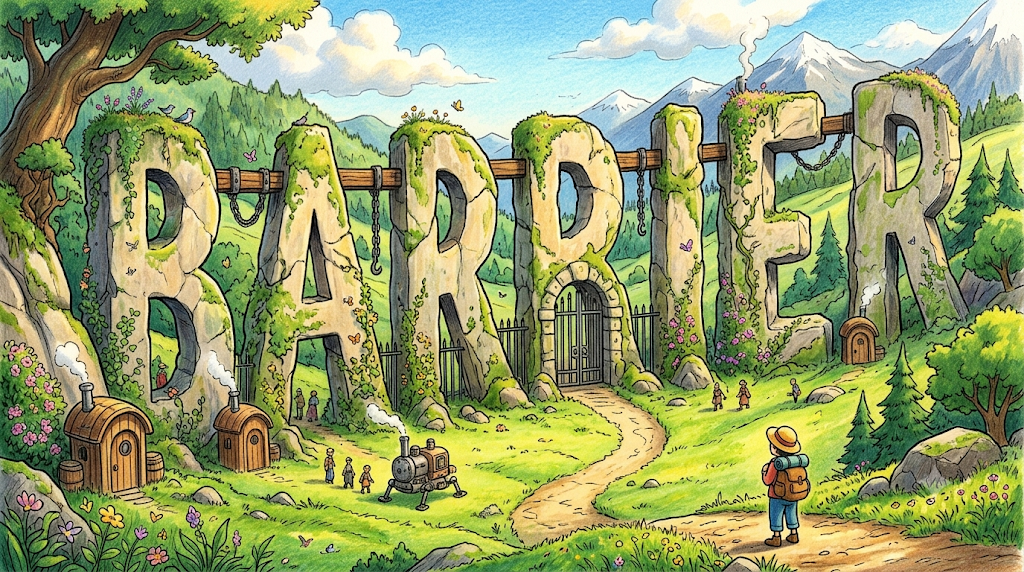
(명사) ① 물리적 장벽, 구조물 (실제 경계·방어)
barrier의 원래 의미로, 눈에 보이는 물리적인 경계나 방어 구조물을 나타냅니다.
- The barriers that separate pedestrians from traffic in urban environments — kerbs, railings, planted medians, and widened footpaths — do not just reduce the physical risk of collision but change the experience of the street, making it feel more human-scaled and encouraging the kinds of slow movement and social interaction that active street life requires. (도시 환경에서 보행자를 교통으로부터 분리하는 장벽들 — 연석, 난간, 식재된 중앙 분리대, 그리고 넓어진 보도 — 은 단순히 충돌의 물리적 위험을 줄이는 것이 아니라 거리의 경험을 바꾸어 더 인간적인 규모처럼 느끼게 하고 활발한 거리 생활이 필요로 하는 종류의 느린 이동과 사회적 상호작용을 장려한다.)
- Natural barriers — mountain ranges, wide rivers, dense forests, and deserts — shaped the development of human civilisations by channelling migration, trade, and conflict along particular routes while preventing others, creating the regional patterns of cultural and technological development that historical geography seeks to explain. (자연 장벽들 — 산맥, 넓은 강, 울창한 숲, 그리고 사막 — 은 특정 경로를 따라 이주, 무역, 그리고 갈등을 유도하는 동시에 다른 것들을 막음으로써 인간 문명의 발전을 형성하여 역사 지리학이 설명하려는 문화적이고 기술적 발전의 지역적 패턴을 만들어냈다.)
- The skin acts as the body's primary barrier against the external environment — protecting internal tissues from physical damage, microbial invasion, ultraviolet radiation, and water loss — a function so fundamental that significant disruption of skin integrity, as in severe burns, becomes immediately life-threatening. (피부는 외부 환경에 대한 신체의 주요 장벽 역할을 한다 — 내부 조직을 물리적 손상, 미생물 침입, 자외선, 그리고 수분 손실로부터 보호하는 — 기능이 너무 근본적이어서 심각한 화상에서처럼 피부 무결성의 상당한 방해가 즉각적으로 생명을 위협하게 된다.)
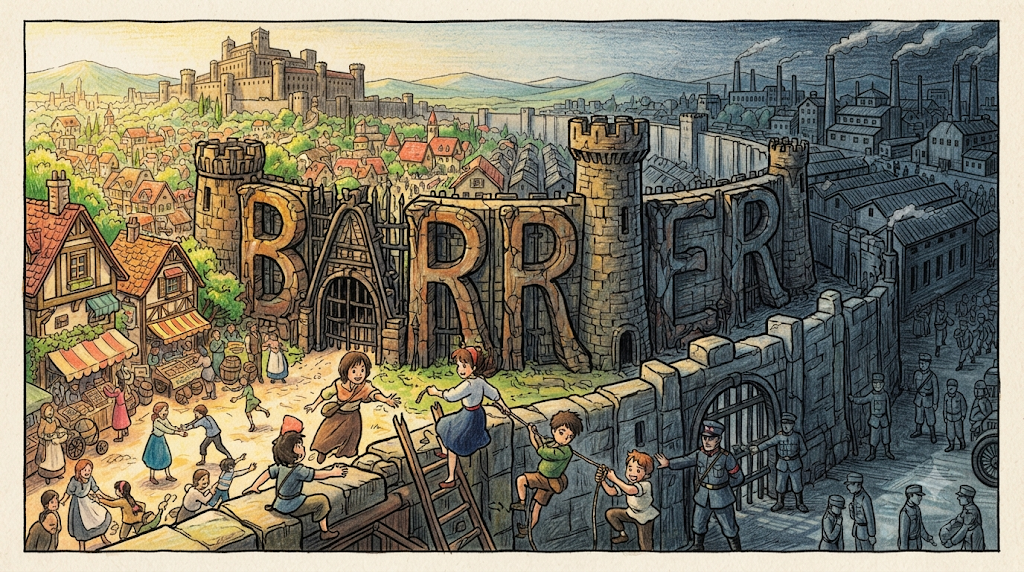
(명사) ② 사회적·제도적 장벽 (차별·불평등·접근 제한)
사회적·제도적으로 사람들의 기회나 참여나 이동을 제한하는 장벽을 나타냅니다. 수능 독해 사회·교육·역사 지문에서 자주 등장합니다.
- The barriers to political participation that have historically been used to exclude particular groups — property qualifications, literacy tests, poll taxes, residency requirements, and voter registration systems designed to discourage use — illustrate that the right to vote can be formally acknowledged while being practically restricted through procedural mechanisms. (역사적으로 특정 집단을 배제하는 데 사용됐던 정치적 참여에 대한 장벽들 — 재산 자격, 문해력 시험, 인두세, 거주 요건, 그리고 사용을 억제하도록 설계된 유권자 등록 시스템 — 은 투표권이 절차적 메커니즘을 통해 실질적으로 제한되는 동안 공식적으로 인정될 수 있다는 것을 보여준다.)
- Glass ceiling barriers — the invisible obstacles that prevent qualified women and minority candidates from advancing to senior leadership positions despite apparent equality of opportunity at lower levels — reflect the persistence of biases that operate below conscious awareness, in hiring committees, performance evaluations, and informal networks that shape career trajectories. (유리 천장 장벽들 — 낮은 단계에서의 기회의 겉보기 평등에도 불구하고 자격을 갖춘 여성과 소수 집단 후보들이 고위 리더십 직위로 승진하는 것을 막는 보이지 않는 장애물 — 은 채용 위원회, 성과 평가, 그리고 경력 궤적을 형성하는 비공식 네트워크에서 의식적 인식 아래에서 작동하는 편견의 지속성을 반영한다.)
- The barriers between academic disciplines — the institutional, methodological, and social structures that separate researchers in different fields and make collaboration difficult — may be efficient within disciplines but often prevent the interdisciplinary insights that are most needed to address complex real-world problems that do not respect disciplinary boundaries. (학문 분야 사이의 장벽들 — 다른 분야의 연구자들을 분리하고 협력을 어렵게 만드는 기관적, 방법론적, 그리고 사회적 구조 — 은 분야 내에서는 효율적일 수 있지만 종종 학문적 경계를 존중하지 않는 복잡한 현실 세계의 문제를 해결하는 데 가장 필요한 학제 간 통찰을 막는다.)

(명사) ③ 심리적·감정적 장벽 (두려움·편견·불신)
눈에 보이지 않지만 사람의 행동이나 관계를 방해하는 심리적 장벽을 나타냅니다.
- The barrier of distrust between communities that have experienced conflict or historical injustice is particularly resistant to simple interventions — while information campaigns can address misconceptions, and contact can reduce prejudice under the right conditions, the deep-seated suspicion that results from real historical grievances requires sustained engagement and credible commitment to change over time. (갈등이나 역사적 불의를 경험한 지역 사회 사이의 불신의 장벽은 특히 단순한 개입에 저항적이다 — 정보 캠페인은 오해를 다룰 수 있고 접촉은 올바른 조건 하에서 편견을 줄일 수 있지만 실제 역사적 불만으로 인한 뿌리 깊은 의혹은 시간이 지나면서 지속적인 참여와 신뢰할 수 있는 변화에 대한 헌신을 필요로 한다.)
- Fear of failure can become a barrier to attempting anything genuinely challenging — when the psychological cost of a poor outcome feels greater than the benefit of a good one, the rational response is to avoid the attempt entirely, which is why educational environments that penalise errors heavily tend to discourage the kind of ambitious effort that produces significant learning. (실패에 대한 두려움은 진정으로 도전적인 어떤 것을 시도하는 것에 대한 장벽이 될 수 있다 — 나쁜 결과의 심리적 비용이 좋은 결과의 혜택보다 더 크게 느껴질 때 합리적인 반응은 시도를 완전히 피하는 것인데 이것이 왜 오류를 심하게 처벌하는 교육 환경이 상당한 학습을 만들어내는 종류의 야심찬 노력을 억제하는 경향이 있는 이유이다.)
- The barrier that professional norms can create between helpers and those they seek to help — the formal distance that maintains the therapeutic or advisory relationship — serves important functions in preventing boundary violations but can also prevent the human connection that makes helping relationships genuinely effective. (도움을 주는 사람들과 그들이 돕고자 하는 사람들 사이에 전문적 규범이 만들 수 있는 장벽 — 치료적이거나 자문적인 관계를 유지하는 공식적인 거리 — 은 경계 위반을 막는 중요한 기능을 하지만 또한 돕는 관계를 진정으로 효과적으로 만드는 인간적 연결을 막을 수 있다.)
뉘앙스·의미 연결 흐름 표
핵심 이미지 연결 흐름 뉘앙스 요약
| 막대기를 가로질러 놓아 아무것도 그 선을 넘지 못하게 하는 것처럼 — 사람이든, 물건이든, 생각이든, 기회든, 어떤 것이 한쪽에서 다른 쪽으로 자유롭게 이동하거나 연결되는 것을 막는 경계선이나 방해물 | 물리적 경계·방어 구조물 → 사회적·제도적 장벽 → 심리적·감정적 장벽 → 기회·접근에 대한 구조적 차단 | 울타리가 사람이나 동물이 경계를 넘는 것을 막는 것처럼, 눈에 보이든 보이지 않든 어떤 흐름이나 이동이나 연결을 차단하는 이미지 |
| 장벽의 성격 | language barrier → cultural barrier → trade barrier | 소통 장벽→이해 장벽→경제 장벽의 이미지 |
| 장벽에 대한 행동 | raise a barrier → overcome a barrier → break down barriers | 장벽 세우기→장벽 극복하기→장벽 허물기의 이미지 |
어원 흐름 표
단어 구성 요소 의미 연결 흐름 뉘앙스 요약
| 고대 프랑스어 barre (막대기·가로막는 것) → barriere | 막대기나 울타리로 만든 물리적 경계 → 어떤 것의 흐름이나 이동이나 연결을 막는 모든 종류의 장애물 | 막대기를 가로질러 놓아 그 선을 넘지 못하게 하는 핵심 이미지 |
| barrier (명사) → bar (동사·막다·금지하다) → barricade (명사·방어 장벽) → embargo (명사·무역 금지) | 장벽·장애물 → 막다·금지하다 → 바리케이드·방어 장벽 → 무역 금지·통상 금지 | 막대기로 경계를 짓는 것에서 다양한 차단과 금지로 확장되는 이미지 |
품사별 의미 표
품사 의미 예문
| 명사 | 물리적 장벽, 방어 구조물 | a barrier along the road (도로를 따라 있는 장벽) |
| 명사 | 사회적·제도적 장벽 | barriers to entry (진입 장벽) |
| 명사 | 심리적·감정적 장벽 | a barrier of distrust (불신의 장벽) |
| 명사 | 언어·문화 장벽 | the language barrier (언어 장벽) |
| 복합명사 | 무역 장벽 | trade barrier (무역 장벽) |
활용 예문 리스트
- The barriers to entrepreneurship — the regulatory requirements, capital access challenges, and network disadvantages — affect different populations very unequally, and since entrepreneurship is one of the primary pathways through which wealth is created, barriers that fall disproportionately on particular demographic groups compound existing inequality across generations. (창업에 대한 장벽들 — 규제 요건, 자본 접근 도전, 그리고 네트워크 불이익 — 은 서로 다른 인구를 매우 불평등하게 영향을 미치며 창업이 부가 창출되는 주요 경로 중 하나이기 때문에 특정 인구통계학적 집단에 불균형적으로 떨어지는 장벽들이 세대에 걸쳐 기존의 불평등을 복합시킨다.)
- Digital technology has removed some barriers between experts and the public — making specialised knowledge more accessible, enabling amateur participation in fields previously reserved for credentialled professionals, and facilitating direct communication between researchers and interested members of the public — while also creating new barriers as credible information becomes harder to distinguish from misinformation in environments of information abundance. (디지털 기술은 전문가와 대중 사이의 일부 장벽들을 제거했다 — 전문화된 지식을 더 접근 가능하게 만들고, 이전에 자격증을 가진 전문가들을 위해 예약됐던 분야에서 아마추어 참여를 가능하게 하며, 연구자와 관심 있는 대중 사이의 직접적인 소통을 촉진하는 것 — 동시에 정보 풍요 환경에서 신뢰할 수 있는 정보가 허위 정보와 구별하기 더 어려워짐에 따라 새로운 장벽들을 만들어냈다.)
- The capacity of ecosystems to act as barriers against natural disasters — coastal wetlands absorbing storm surge, forests reducing flood risk, mangroves protecting coastlines from erosion — represents an economic value that is difficult to quantify but that becomes painfully apparent when these natural barriers are removed and the full cost of replacement with engineered alternatives becomes clear. (자연재해에 대한 장벽 역할을 하는 생태계의 능력 — 폭풍 해일을 흡수하는 해안 습지, 홍수 위험을 줄이는 숲, 침식으로부터 해안선을 보호하는 맹그로브 — 은 정량화하기 어렵지만 이 자연 장벽들이 제거되고 공학적 대안으로의 교체의 전체 비용이 명확해질 때 고통스럽게 명백해지는 경제적 가치를 나타낸다.)
- The relationship between trade barriers and economic development is more complex than either free trade advocates or protectionists acknowledge — historical evidence suggests that some degree of protection during early industrialisation has often preceded successful development, while also showing that protection maintained too long tends to entrench inefficiency rather than support the emergence of competitive industries. (무역 장벽과 경제 발전 사이의 관계는 자유 무역 옹호론자나 보호주의자 어느 쪽이 인정하는 것보다 더 복잡하다 — 역사적 증거는 초기 산업화 동안의 어느 정도의 보호가 종종 성공적인 발전에 선행했다는 것을 시사하는 반면 또한 너무 오래 유지된 보호는 경쟁력 있는 산업의 출현을 지원하기보다 비효율성을 고착시키는 경향이 있다는 것을 보여준다.)
- Public health interventions that successfully break down barriers to vaccination — by bringing services to where people are rather than requiring them to come to fixed facilities, reducing the time and cost of access, and addressing specific concerns of hesitant populations — consistently produce higher uptake rates than campaigns that focus on persuasion alone without addressing the structural barriers that make following advice difficult. (예방접종에 대한 장벽을 성공적으로 허무는 공중 보건 개입들 — 사람들이 고정된 시설에 오도록 요구하기보다 그들이 있는 곳에 서비스를 가져오고, 접근의 시간과 비용을 줄이며, 망설이는 인구의 특정 우려를 해결함으로써 — 은 조언을 따르는 것을 어렵게 만드는 구조적 장벽들을 해결하지 않고 설득에만 집중하는 캠페인보다 지속적으로 더 높은 채택률을 만들어낸다.)
전체 뉘앙스 설명
barrier는 '막대기를 가로질러 놓아 아무것도 그 선을 넘지 못하게 하는 것처럼 사람이든, 물건이든, 생각이든, 기회든 어떤 것이 한쪽에서 다른 쪽으로 자유롭게 이동하거나 연결되는 것을 막는 경계선이나 방해물에서 출발하는 모든 물리적 장벽·언어 장벽·무역 장벽·문화 장벽·심리적 장벽·사회적 장벽의 언어'입니다.
obstacle과의 차이: obstacle은 앞길을 막고 있어서 넘어서거나 피해야 하는 구체적이고 개별적인 어려움을 강조하고, barrier는 더 구체적으로 어떤 흐름이나 이동이나 연결 자체를 막는 구조적이고 지속적인 경계를 강조합니다. hindrance와의 차이: hindrance는 어떤 것을 완전히 막지는 않지만 방해하고 늦추는 것을 강조하고, barrier는 더 구체적으로 그 경계선이 있는 한 흐름이나 이동이 일어나지 못하게 되는 더 완전하고 구조적인 차단을 강조합니다. wall과의 차이: wall은 구체적으로 물리적인 벽을 가리키고, barrier는 더 넓게 물리적이든 비물리적이든 어떤 종류의 장애물도 포함하는 더 광범위한 개념입니다.
마지막 핵심 정리
barrier는 단순히 "장벽"이 아닙니다 — 고대 프랑스어 barriere(울타리, 막대기로 막은 것)에서 출발해, ~에 대한 장벽(barrier to)·장벽을 허물다(break down barriers)·언어 장벽(language barrier)·무역 장벽(trade barrier)·장벽을 극복하다(overcome a barrier)·~ 사이의 장벽(barrier between)·문화 장벽(cultural barrier)·장벽을 세우다(raise a barrier)·장벽 없는(barrier free)·장벽 역할을 하다(act as a barrier)까지 확장되는 단어이며, barrier vs. obstacle vs. hindrance의 뉘앙스 구별·barrier to·break down barriers·act as a barrier 패턴이 수능 핵심 출제 포인트입니다.
파생어 표 (발음기호 포함)
파생어 발음기호 품사 의미
| bar | [bɑːr] | 동사/명사 | 막다, 금지하다 / 막대기, 장벽 |
| barricade | [ˌbærɪˈkeɪd] | 명사/동사 | 바리케이드, 방어 장벽 / 바리케이드를 치다 |
| embargo | [ɪmˈbɑːrɡəʊ] | 명사 | 무역 금지, 통상 금지령 |
| barrier-free | [ˈbæriər friː] | 형용사 | 장벽 없는, 무장애의 |
유의어 비교표
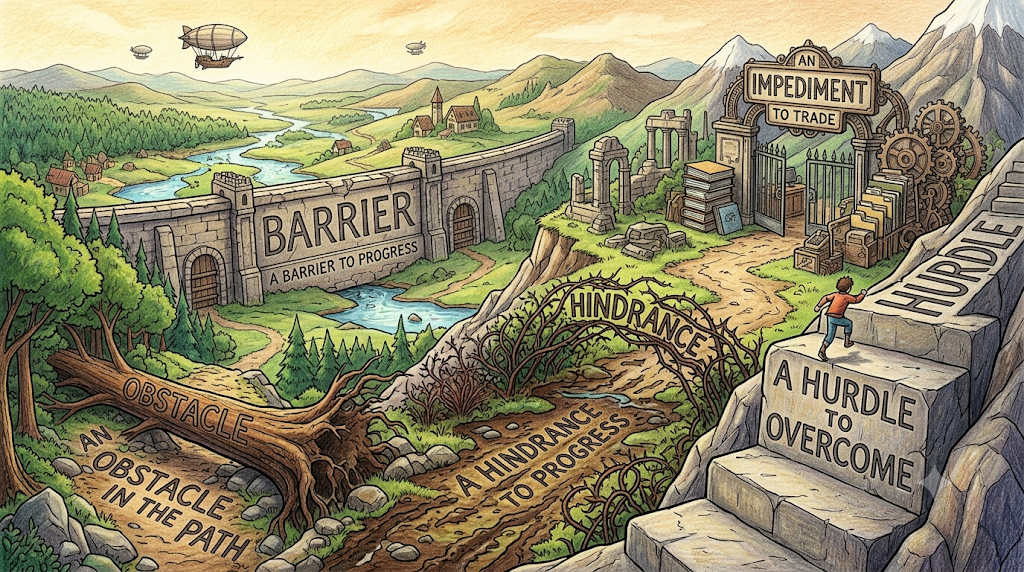
단어 공통점 뉘앙스 차이 예문
| barrier | 방해 관련 | 흐름이나 이동이나 연결을 막는 구조적이고 지속적인 경계, 사회적·제도적 성격이 강함 강조 | a barrier to progress |
| obstacle | 방해 관련 | 앞길을 막고 있어서 넘어서거나 피해야 하는 구체적이고 개별적인 어려움 강조 | an obstacle in the path |
| hindrance | 방해 관련 | 어떤 것을 완전히 막지는 않지만 방해하고 늦추는 것, 진행을 어렵게 만드는 것 강조 | a hindrance to progress |
| impediment | 방해 관련 | 어떤 것의 진행이나 발전을 막거나 늦추는 공식적이고 구조적인 방해물 강조 | an impediment to trade |
| hurdle | 방해 관련 | 넘어야 하는 도전이나 어려움, 특히 달성 과정에서의 단계적 장애 강조 | a hurdle to overcome |
유의어 예문 리스트
- (obstacle) The most significant obstacle that many first-generation university students face is not academic preparation but the navigational challenge of understanding how to apply for financial aid, choose courses, access support services, and build the professional networks that degree programmes assume students already have access to. (많은 1세대 대학생들이 직면하는 가장 중요한 장애물은 학업 준비가 아니라 재정 지원 신청 방법, 강의 선택, 지원 서비스 접근, 그리고 학위 프로그램이 학생들이 이미 접근할 수 있다고 가정하는 전문적 네트워크 구축을 이해하는 탐색 도전이다.)
- (hindrance) Excessive documentation requirements in clinical settings — where healthcare workers must record every interaction in detail to satisfy administrative and insurance requirements — have become a significant hindrance to patient care, consuming time that would otherwise be spent on direct care and contributing to professional burnout. (임상 환경에서의 과도한 문서화 요건 — 의료 종사자들이 행정 및 보험 요건을 충족하기 위해 모든 상호작용을 세부적으로 기록해야 하는 — 은 환자 돌봄에 대한 중요한 방해물이 됐으며 그렇지 않으면 직접적인 돌봄에 사용됐을 시간을 소비하고 직업적 번아웃에 기여한다.)
- (impediment) Intellectual property regimes that were designed to incentivise innovation by granting temporary monopolies on new products and processes have in some sectors become impediments to further innovation — when patent thickets, evergreening practices, and licensing barriers make it difficult for new entrants to build on existing work, the system can slow rather than accelerate technological development. (새로운 제품과 프로세스에 대한 일시적인 독점권을 부여하여 혁신에 인센티브를 주기 위해 설계된 지적 재산 체제는 일부 분야에서 추가 혁신에 대한 장애물이 됐다 — 특허 덤불, 상시 갱신 관행, 그리고 라이선싱 장벽이 새로운 진입자들이 기존 작업을 기반으로 구축하기 어렵게 만들 때 시스템이 기술 개발을 가속화하기보다 늦출 수 있다.)
- (hurdle) The regulatory approval process for new drugs represents a series of hurdles designed to ensure safety and efficacy before treatments reach patients — early phase trials establish basic safety, later phases test efficacy at scale, and post-market surveillance continues to monitor real-world effects after approval. (새로운 약물에 대한 규제 승인 과정은 치료법이 환자에게 도달하기 전에 안전성과 효과성을 보장하기 위해 설계된 일련의 허들들을 나타낸다 — 초기 단계 시험이 기본 안전성을 확립하고, 이후 단계가 규모에서 효과성을 시험하며, 시판 후 감시가 승인 후 실제 세계 효과를 계속 모니터링한다.)
결론 정리
barrier는 단순히 "장벽"이 아니라, 막대기를 가로질러 놓아 아무것도 그 선을 넘지 못하게 하는 것처럼 사람이든, 물건이든, 생각이든, 기회든 어떤 것이 한쪽에서 다른 쪽으로 자유롭게 이동하거나 연결되는 것을 막는 경계선이나 방해물의 이미지에서 출발해 ~에 대한 장벽·장벽을 허물다·언어 장벽·무역 장벽·장벽을 극복하다·~ 사이의 장벽·문화 장벽·장벽을 세우다·장벽 없는·장벽 역할을 하다까지 확장되는 단어다 — barrier가 있는 곳엔 언제나 '울타리가 사람이나 동물이 경계를 넘는 것을 막는 것처럼, 눈에 보이든 보이지 않든 어떤 흐름이나 이동이나 연결이 자유롭게 이루어지지 못하도록 그 경계에서 차단하는' 구조적 방해의 이미지가 있다.
💡 barrier는 "어떤 것의 흐름이나 이동이나 연결이 이루어지는 것을 막는 경계선이나 방해물 — 물리적 울타리에서 언어·문화·경제·심리적 장벽까지, 눈에 보이든 보이지 않든 그 경계를 넘는 것을 어렵게 만드는 것을 가리키는" 단어 — barrier to·break down barriers·act as a barrier 가 수능 최빈출. obstacle(구체적 개별 장애물)·hindrance(완전히 막지 않고 방해·늦춤)와의 구별이 핵심 출제 포인트.
🌟 초등학생 버전 barrier는 단순히 "장벽"이 아니에요! barrier to는 도서관에 가서 좋은 책을 읽고 싶은데 읽고 싶은 책들이 모두 어려운 영어로만 쓰여 있어서 아무리 열심히 하고 싶어도 시작조차 못하게 되는 것처럼 하고 싶은 것이 있어도 그 앞에 딱 버티고 서서 나아가지 못하게 만드는 것이고, break down barriers는 처음에 서로 말도 안 하고 따로 밥 먹던 두 반 아이들이 같이 운동회 팀이 되어 함께 연습하고 응원하다 보니 어느새 서로 이름도 알고 같이 웃게 되는 것처럼 원래 사람들 사이를 갈라놓던 벽이 함께하는 경험을 통해 조용히 사라지는 것이에요! 🌍✨

barrier to [ˈbæriər tuː]
품사/뉘앙스 설명
(명사구) ~에 대한 장벽, ~을 가로막는 장애물
어떤 것을 달성하거나 접근하거나 이루는 것을 방해하는 장애물을 강조합니다. 장벽이 구조적이어서 개인의 노력만으로는 넘기 어렵다는 것이 핵심 뉘앙스입니다. 수능 독해 사회·교육·경제 지문의 핵심 표현입니다.
- The barrier to accessing legal remedies for workplace discrimination — the cost of legal representation, the time required, the fear of retaliation, and the difficulty of proving intent rather than effect — means that many instances of discrimination go unchallenged not because the victims lack rights but because exercising those rights is prohibitively difficult in practice. (직장 차별에 대한 법적 구제에 접근하는 장벽 — 법적 대리의 비용, 필요한 시간, 보복에 대한 두려움, 그리고 효과보다 의도를 증명하는 어려움 — 은 차별의 많은 경우가 피해자들이 권리가 없어서가 아니라 실제로 그 권리를 행사하는 것이 엄청나게 어렵기 때문에 이의를 제기하지 않고 지나간다는 것을 의미한다.)
- Geographic remoteness remains a significant barrier to receiving high-quality medical care in many parts of the world — a challenge that telemedicine has begun to address but not yet solved, since some diagnostic and therapeutic interventions still require physical presence and the infrastructure to support telemedicine is itself unevenly distributed. (지리적 원격성은 세계의 많은 지역에서 고품질 의료 돌봄을 받는 데 있어 여전히 중요한 장벽으로 남아있다 — 원격 의료가 해결하기 시작했지만 아직 해결하지 못한 도전인데 일부 진단 및 치료 개입이 여전히 물리적 존재를 필요로 하고 원격 의료를 지원하는 인프라 자체가 불균등하게 분배되기 때문이다.)
- Social norms can function as invisible barriers to behaviour change — when healthy habits, seeking mental health support, or reporting wrongdoing are associated with social disapproval within a community, the cost of the behaviour in social terms can outweigh the private benefit, explaining why structural and cultural change often needs to accompany individual-level interventions. (사회적 규범은 행동 변화에 대한 보이지 않는 장벽으로 기능할 수 있다 — 건강한 습관, 정신 건강 지원 구하기, 또는 비위 신고가 지역 사회 내에서 사회적 불승인과 연관될 때 사회적 측면에서의 행동 비용이 사적 혜택을 능가할 수 있어 왜 구조적이고 문화적 변화가 종종 개인 수준의 개입을 동반해야 하는지를 설명한다.)
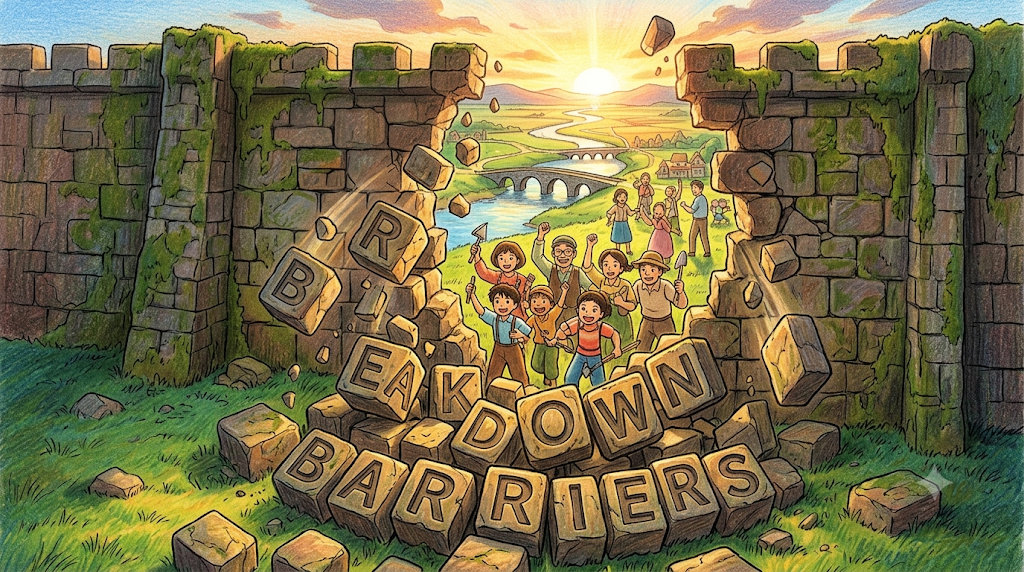
break down barriers [breɪk daʊn ˈbæriərz]
품사/뉘앙스 설명
(동사구) 장벽을 허물다, 장애물을 제거하다
사람들 사이의 이해·소통·협력을 가로막던 장벽을 제거하는 것을 강조합니다. 장벽이 허물어진 후 새로운 연결이 생긴다는 것이 핵심 뉘앙스입니다. 수능 독해 사회·교육·심리 지문의 핵심 표현입니다.
- International scientific collaboration has proven to be one of the most effective mechanisms for breaking down barriers between nations that have political tensions at the governmental level — when scientists cooperate on shared research questions, the professional relationships that form can outlast and survive political upheavals that would have otherwise made such exchanges impossible. (국제 과학 협력은 정부 수준에서 정치적 긴장이 있는 국가들 사이의 장벽을 허무는 가장 효과적인 메커니즘 중 하나임이 증명됐다 — 과학자들이 공유된 연구 질문에서 협력할 때 형성되는 전문적 관계가 그렇지 않으면 그러한 교류를 불가능하게 만들었을 정치적 격변을 이겨내고 살아남을 수 있다.)
- The history of social movements that have successfully broken down barriers to equality — whether for racial minorities, women, LGBTQ+ people, or people with disabilities — reveals a consistent pattern: legal change typically follows rather than precedes shifts in public attitudes, and those shifts in attitude are produced by a combination of visible advocacy, personal relationships across divides, and changed representations in media and culture. (평등에 대한 장벽을 성공적으로 허문 사회 운동의 역사 — 인종적 소수자, 여성, LGBTQ+ 사람들, 또는 장애인을 위해서든 — 는 일관된 패턴을 드러낸다: 법적 변화는 전형적으로 대중 태도의 변화에 선행하기보다 따르며, 태도의 그 변화들은 가시적인 옹호, 분리를 넘는 개인적 관계, 그리고 미디어와 문화에서의 변화된 표현의 조합에 의해 만들어진다.)
- Technology that breaks down barriers between experts and non-experts — making specialised knowledge accessible without requiring years of training to understand — has democratised access to information in ways that have both empowered individuals and created new challenges, since the same accessibility that puts expertise within reach also puts misinformation within reach. (전문가와 비전문가 사이의 장벽을 허무는 기술 — 전문화된 지식을 이해하기 위해 수년간의 훈련을 필요로 하지 않고 접근 가능하게 만드는 — 은 개인에게 힘을 주는 방식과 새로운 도전을 만드는 방식 모두로 정보에 대한 접근을 민주화했는데 전문 지식을 가까이 두는 같은 접근성이 또한 허위 정보를 가까이 둔다.)
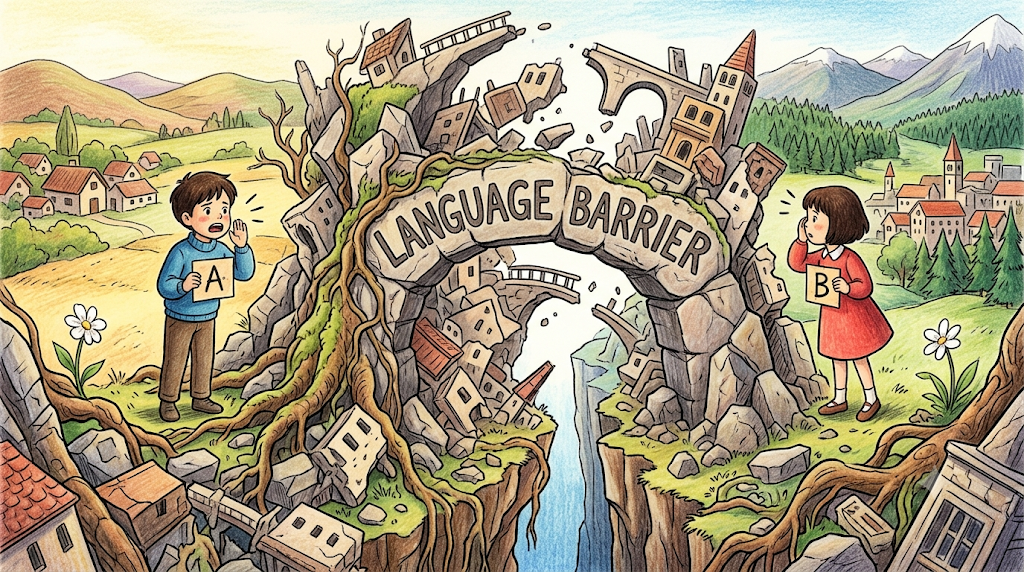
language barrier [ˈlæŋɡwɪdʒ ˈbæriər]
품사/뉘앙스 설명
(명사구) 언어 장벽
서로 다른 언어를 사용하는 사람들 사이에서 소통과 이해를 방해하는 장애물을 강조합니다. 언어 장벽이 단순한 소통 문제를 넘어 사회적 통합 문제임이 핵심 뉘앙스입니다. 수능 독해 사회·교육·심리 지문의 핵심 표현입니다.
- The language barrier in healthcare settings — when patients cannot communicate their symptoms clearly and practitioners cannot explain diagnoses and treatment options accurately — creates risks that go well beyond miscommunication, because clinical decisions made on incomplete information can result in inappropriate treatment, missed diagnoses, and preventable adverse outcomes. (의료 환경에서의 언어 장벽 — 환자들이 증상을 명확하게 소통할 수 없고 의료진이 진단과 치료 옵션을 정확하게 설명할 수 없을 때 — 은 의사소통 오류를 훨씬 넘어서는 위험을 만드는데 불완전한 정보로 내려진 임상 결정이 부적절한 치료, 놓친 진단, 그리고 예방 가능한 부작용을 초래할 수 있기 때문이다.)
- Children who grow up speaking a minority language at home and must acquire the dominant language of schooling face a language barrier that is qualitatively different from that faced by adult immigrants — they are simultaneously learning language and learning through language, and research consistently shows that strong literacy in the first language facilitates rather than hinders the acquisition of a second. (가정에서 소수 언어를 사용하고 학교 교육의 지배적인 언어를 습득해야 하는 아이들은 성인 이민자들이 직면하는 것과 질적으로 다른 언어 장벽에 직면한다 — 그들은 동시에 언어를 배우고 언어를 통해 배우고 있으며 연구는 지속적으로 첫 번째 언어에서의 강한 문해력이 두 번째 언어 습득을 방해하기보다 촉진한다는 것을 보여준다.)
- International scientific communication has largely overcome the language barrier through the global adoption of English as the dominant language of academic publishing — but this has also created a secondary barrier for scientists whose first language is not English, who face additional burdens of writing, reviewing, and presenting in a second language that their native-English-speaking peers do not. (국제 과학 소통은 학술 출판의 지배적인 언어로서 영어의 글로벌 채택을 통해 언어 장벽을 대체로 극복했다 — 하지만 이것은 또한 모국어가 영어가 아닌 과학자들을 위한 부차적인 장벽을 만들었는데 그들은 모국어가 영어인 동료들은 직면하지 않는 두 번째 언어로 쓰고, 검토하며, 발표하는 추가적인 부담에 직면한다.)
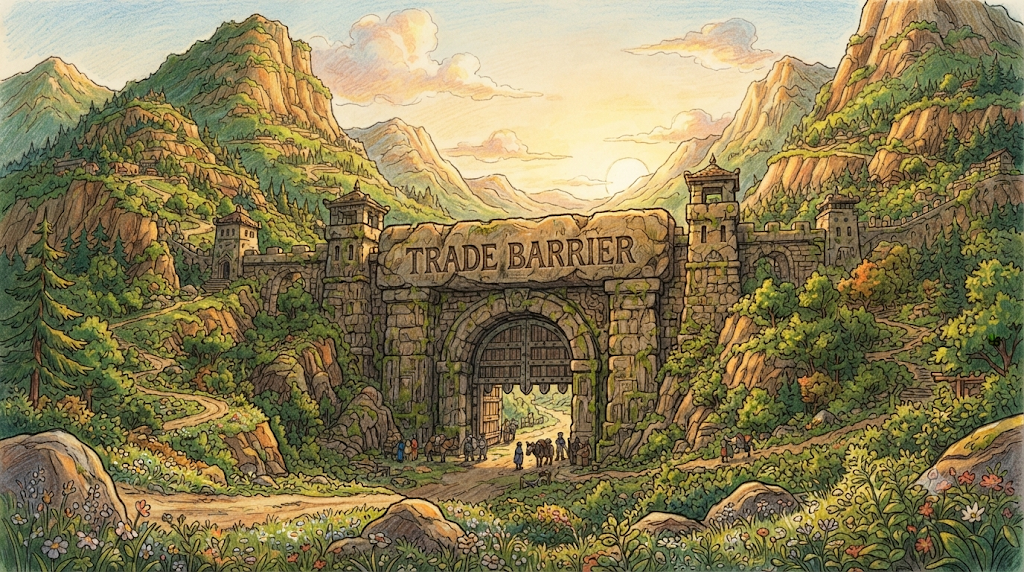
trade barrier [treɪd ˈbæriər]
품사/뉘앙스 설명
(명사구) 무역 장벽
국가 간의 상품이나 서비스의 자유로운 이동을 제한하는 관세·규제·할당제 등을 강조합니다. 무역 장벽의 경제적 효과가 의도와 다를 수 있다는 것이 핵심 뉘앙스입니다. 수능 독해 경제·사회·역사 지문의 핵심 표현입니다.
- Trade barriers can take forms that are difficult to identify and challenge because they appear as legitimate regulatory requirements — product standards, testing requirements, labelling rules, and sanitary regulations that nominally protect consumers or the environment but that are in practice designed to disadvantage foreign competitors, a category known as non-tariff barriers. (무역 장벽은 합법적인 규제 요건으로 보이기 때문에 파악하고 이의를 제기하기 어려운 형태를 취할 수 있다 — 제품 표준, 테스트 요건, 라벨링 규칙, 그리고 명목상으로 소비자나 환경을 보호하지만 실제로 외국 경쟁자들을 불리하게 하도록 설계된 위생 규정 — 비관세 장벽으로 알려진 범주이다.)
- The political economy of trade barriers explains why they persist even when economic analysis consistently demonstrates their costs — the losses from protection are diffuse (spread across all consumers who pay higher prices) while the gains are concentrated (accruing to specific industries and their workers), giving the beneficiaries much stronger incentives to organise politically than the dispersed losers. (무역 장벽의 정치 경제학은 경제 분석이 지속적으로 그것들의 비용을 입증할 때도 왜 그것들이 지속되는지를 설명한다 — 보호로부터의 손실이 분산되는 반면(더 높은 가격을 지불하는 모든 소비자들에 걸쳐 확산) 이익이 집중된다(특정 산업과 그것들의 노동자들에게 발생) — 수혜자들에게 분산된 패자들보다 정치적으로 조직하는 훨씬 더 강한 인센티브를 준다.)
- Developing countries have historically argued that trade barriers maintained by wealthy countries against their exports — particularly in agriculture, textiles, and other labour-intensive industries where developing countries have comparative advantage — undermine the development potential that trade integration is supposed to create, because these are precisely the sectors where they would otherwise be most competitive. (개발도상국들은 부유한 나라들이 자국의 수출에 대해 유지하는 무역 장벽들 — 특히 개발도상국들이 비교 우위를 갖는 농업, 섬유, 그리고 다른 노동 집약적 산업에서 — 이 무역 통합이 만들어야 하는 개발 잠재력을 약화시킨다고 역사적으로 주장했는데 이것들이 정확히 그들이 그렇지 않으면 가장 경쟁력이 있을 분야이기 때문이다.)
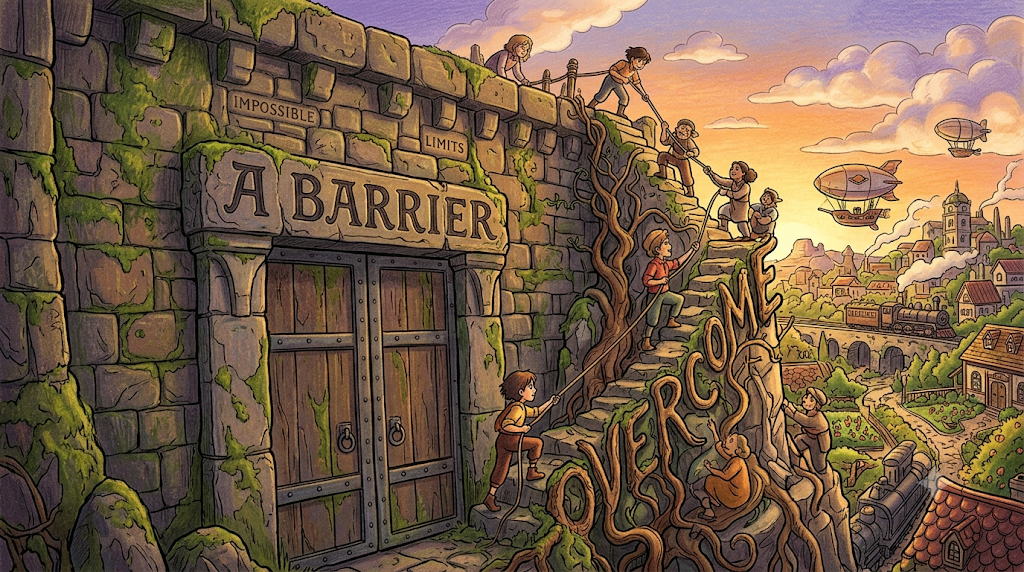
overcome a barrier [ˌəʊvəˈkʌm ə ˈbæriər]
품사/뉘앙스 설명
(동사구) 장벽을 극복하다, 장애물을 넘어서다
앞을 막고 있는 장벽이나 어려움을 이겨내고 나아가는 것을 강조합니다. 장벽 극복이 개인의 노력과 구조적 지원 모두를 필요로 한다는 것이 핵심 뉘앙스입니다. 수능 독해 사회·심리·교육 지문에서 자주 등장합니다.
- Refugees who successfully overcome the barriers of language, credential recognition, cultural adjustment, and social isolation to achieve economic and social integration typically do so not through individual effort alone but through a combination of personal resilience, supportive community connections, and institutional frameworks that facilitate rather than obstruct the integration process. (언어, 자격증 인정, 문화 적응, 그리고 사회적 고립의 장벽들을 성공적으로 극복하여 경제적이고 사회적 통합을 달성하는 난민들은 전형적으로 개인적 노력만을 통해서가 아니라 개인적 회복탄력성, 지지하는 지역 사회 연결, 그리고 통합 과정을 방해하기보다 촉진하는 기관적 틀의 조합을 통해 그렇게 한다.)
- The history of science is partly a history of overcoming barriers imposed by existing paradigms — the resistance to new ideas not because they lack evidence but because they conflict with established frameworks — and the scientists who overcome these barriers typically face not just intellectual but social and professional challenges in having their contributions recognised. (과학의 역사는 부분적으로 기존 패러다임에 의해 부과된 장벽들을 극복하는 역사이다 — 새로운 아이디어들이 증거가 부족해서가 아니라 확립된 틀과 충돌하기 때문에 저항받는 것 — 그리고 이 장벽들을 극복하는 과학자들은 전형적으로 기여를 인정받는 데 있어 지적 도전만이 아니라 사회적이고 직업적 도전에도 직면한다.)
- The strategies most effective at helping young people from disadvantaged backgrounds overcome barriers to higher education — intensive tutoring and academic preparation, but also mentoring by relatable role models, support with application processes, and financial assistance during the transition — suggest that the barriers are multiple and interconnected, and that addressing only one without the others produces limited results. (불리한 배경을 가진 젊은 사람들이 고등 교육에 대한 장벽들을 극복하도록 돕는 데 가장 효과적인 전략들 — 집중적인 과외와 학업 준비, 하지만 또한 공감할 수 있는 역할 모델에 의한 멘토링, 지원 과정에 대한 도움, 그리고 전환 기간 동안의 재정 지원 — 은 장벽들이 다양하고 상호 연결되어 있으며 다른 것들 없이 하나만을 다루는 것이 제한된 결과를 만들어낸다는 것을 시사한다.)

barrier between [ˈbæriər bɪˈtwiːn]
품사/뉘앙스 설명
(명사구) ~ 사이의 장벽
두 사람이나 두 집단이나 두 상태 사이를 가로막고 있는 장애물을 강조합니다. 장벽이 양쪽 모두에 영향을 준다는 것이 핵심 뉘앙스입니다. 수능 독해 사회·심리·역사 지문에서 자주 등장합니다.
- The barrier between scientific knowledge and effective policy action is not primarily informational — policymakers generally know what the evidence says — but political and institutional: the difficulty of building coalitions for policies whose benefits are diffuse and future while costs are concentrated and present, and the short timescales of electoral politics relative to the long timescales of many social and environmental problems. (과학적 지식과 효과적인 정책 행동 사이의 장벽은 주로 정보적이지 않다 — 정책 입안자들은 일반적으로 증거가 무엇을 말하는지 안다 — 하지만 정치적이고 기관적이다: 비용이 집중되고 현재에 있는 반면 혜택이 분산되고 미래에 있는 정책을 위한 연합 구축의 어려움, 그리고 많은 사회적이고 환경적 문제의 긴 시간 틀에 비해 선거 정치의 짧은 시간 틀이다.)
- The barrier between different socioeconomic groups that residential segregation creates — when wealthy and poor communities occupy entirely separate physical spaces, attend different schools, use different services, and rarely encounter one another in daily life — reduces the shared experience and mutual understanding that democratic solidarity depends on. (주거 분리가 만드는 다른 사회경제적 집단들 사이의 장벽 — 부유하고 가난한 지역 사회가 완전히 별개의 물리적 공간을 점유하고, 다른 학교에 다니며, 다른 서비스를 이용하고, 일상 생활에서 서로를 거의 마주치지 않을 때 — 은 민주주의적 연대가 의존하는 공유된 경험과 상호 이해를 줄인다.)
- Grief can create a barrier between the bereaved and those around them — not because others are unwilling to help but because they are uncertain how to do so, and because the bereaved may need something that social convention and others' discomfort make difficult to offer: acknowledgment of the loss and tolerance for the expression of grief, rather than reassurance that everything will be fine. (슬픔은 사별한 사람과 주변 사람들 사이의 장벽을 만들 수 있다 — 다른 사람들이 돕기를 꺼려해서가 아니라 어떻게 그렇게 해야 할지 불확실하기 때문에, 그리고 사별한 사람이 사회적 관습과 다른 사람들의 불편함이 제공하기 어렵게 만드는 것을 필요로 할 수 있기 때문이다: 모든 것이 괜찮을 것이라는 확신이 아닌 상실의 인정과 슬픔 표현에 대한 관용이다.)
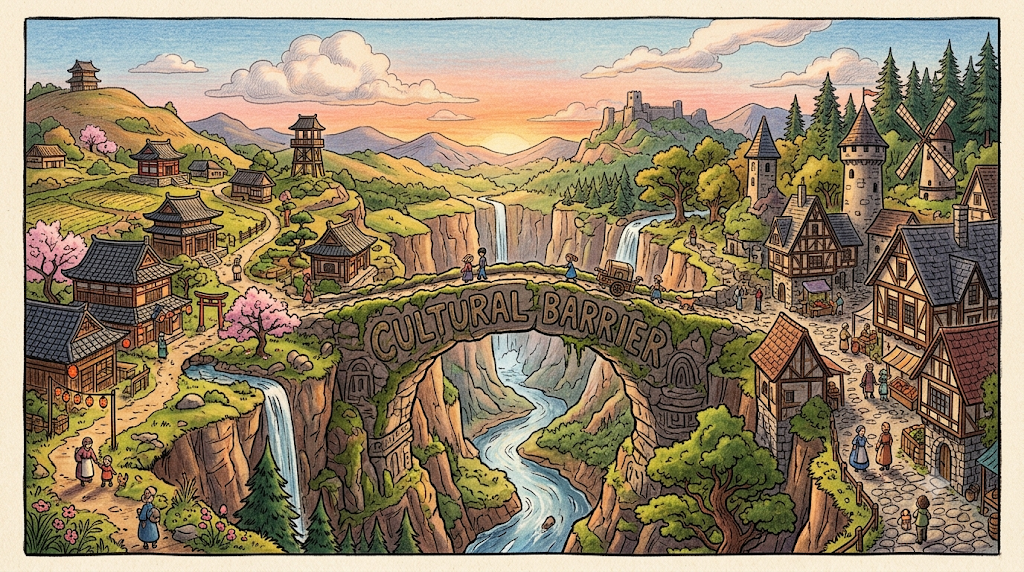
cultural barrier [ˈkʌltʃərəl ˈbæriər]
품사/뉘앙스 설명
(명사구) 문화 장벽
서로 다른 문화적 배경이나 가치관·관습의 차이로 인해 이해와 소통을 방해하는 장애물을 강조합니다. 문화 장벽이 의도하지 않게 만들어진다는 것이 핵심 뉘앙스입니다. 수능 독해 사회·교육·역사 지문에서 자주 등장합니다.
- Cultural barriers to the adoption of new agricultural practices — when innovations that would increase yields or reduce environmental impact are inconsistent with the social norms, traditional knowledge systems, or economic relationships embedded in existing farming practices — illustrate that technical solutions to agricultural problems must be socially embedded to be effective. (새로운 농업 관행 채택에 대한 문화적 장벽들 — 수확량을 늘리거나 환경 영향을 줄일 혁신이 기존 농업 관행에 포함된 사회적 규범, 전통 지식 시스템, 또는 경제적 관계와 일치하지 않을 때 — 은 농업 문제에 대한 기술적 해결책이 효과적이기 위해 사회적으로 포함되어야 한다는 것을 보여준다.)
- The cultural barriers that impede cross-cultural negotiation — different assumptions about how directly disagreement should be expressed, whether agreements should be finalised in the meeting or require subsequent internal consultation, and how binding oral commitments are before written contracts are signed — can produce misunderstandings that are experienced as bad faith by both parties even when neither intends to act dishonestly. (교차 문화 협상을 방해하는 문화적 장벽들 — 의견 불일치가 얼마나 직접적으로 표현되어야 하는지, 합의가 회의에서 마무리되어야 하는지 또는 이후 내부 협의가 필요한지, 그리고 서면 계약이 서명되기 전에 구두 약속이 얼마나 구속력이 있는지에 대한 다른 가정들 — 은 어느 쪽도 부정직하게 행동하려 하지 않을 때도 두 당사자 모두에 의해 나쁜 신의로 경험되는 오해를 만들어낼 수 있다.)
- Cultural barriers within organisations — the unspoken norms about how problems are discussed, who can challenge senior colleagues, and what kinds of concerns are considered legitimate — often determine whether safety-critical information flows to where it can be acted upon, which is why aviation, medicine, and nuclear power have invested heavily in developing cultures where junior staff feel safe to raise concerns with seniors. (조직 내 문화적 장벽들 — 문제가 어떻게 논의되는지, 누가 선임 동료에게 이의를 제기할 수 있는지, 그리고 어떤 종류의 우려가 합법적인 것으로 여겨지는지에 대한 말해지지 않은 규범 — 은 종종 안전에 중요한 정보가 조치될 수 있는 곳으로 흘러가는지를 결정하는데 이것이 왜 항공, 의학, 그리고 핵 발전소가 하급 직원들이 선임자들에게 우려를 제기하는 것이 안전하다고 느끼는 문화를 개발하는 데 많이 투자한 이유이다.)
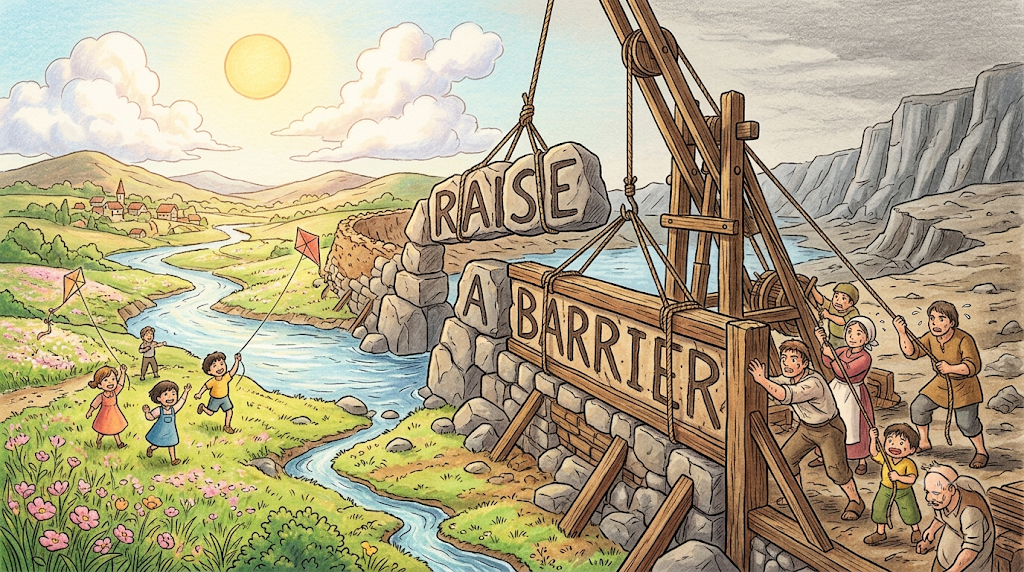
raise a barrier [reɪz ə ˈbæriər]
품사/뉘앙스 설명
(동사구) 장벽을 세우다, 장애물을 만들다
어떤 것의 흐름이나 접근이나 연결을 방해하는 장벽을 의도적으로 만들거나 높이는 것을 강조합니다. 장벽을 세우는 것이 보호와 차별 사이에 있다는 것이 핵심 뉘앙스입니다. 수능 독해 사회·경제·역사 지문에서 자주 등장합니다.
- Populist movements that raise barriers against perceived outsiders — whether immigrants, foreign goods, or supranational institutions — often do so by arguing that the barriers protect ordinary citizens from forces beyond their control, but the economic and social costs of such barriers typically fall most heavily on those the movements claim to protect. (인지된 외부인에 대한 장벽을 세우는 포퓰리스트 운동들 — 이민자, 외국 상품, 또는 초국가적 기관이든 — 은 종종 장벽이 통제 불가능한 힘으로부터 일반 시민들을 보호한다고 주장함으로써 그렇게 하지만 그러한 장벽들의 경제적이고 사회적 비용은 전형적으로 운동들이 보호한다고 주장하는 사람들에게 가장 무겁게 떨어진다.)
- Digital platforms that raise barriers to switching — through proprietary formats, data portability restrictions, and ecosystem lock-in — reduce competition in ways that may harm consumers and innovation even when the individual products are of high quality, which is why data portability and interoperability have become central concerns in digital platform regulation. (독점 형식, 데이터 이식성 제한, 그리고 생태계 잠금을 통해 전환에 대한 장벽을 세우는 디지털 플랫폼들 — 은 개별 제품이 높은 품질이더라도 소비자와 혁신을 해칠 수 있는 방식으로 경쟁을 줄이는데 이것이 왜 데이터 이식성과 상호 운용성이 디지털 플랫폼 규제의 핵심 우려가 됐는지의 이유이다.)
- The decision to raise barriers to immigration at particular historical moments — through quotas, national origin preferences, or point systems — reflects not just economic calculations about labour market impacts but deeper social anxieties about national identity, cultural change, and the pace at which receiving societies can absorb and integrate newcomers. (특정 역사적 순간에 이민에 대한 장벽을 세우기로 한 결정 — 할당제, 국가 출신 선호, 또는 포인트 시스템을 통해 — 은 단순히 노동 시장 영향에 대한 경제적 계산을 반영하는 것이 아니라 국가 정체성, 문화적 변화, 그리고 수용 사회가 신참자들을 흡수하고 통합할 수 있는 속도에 대한 더 깊은 사회적 불안도 반영한다.)
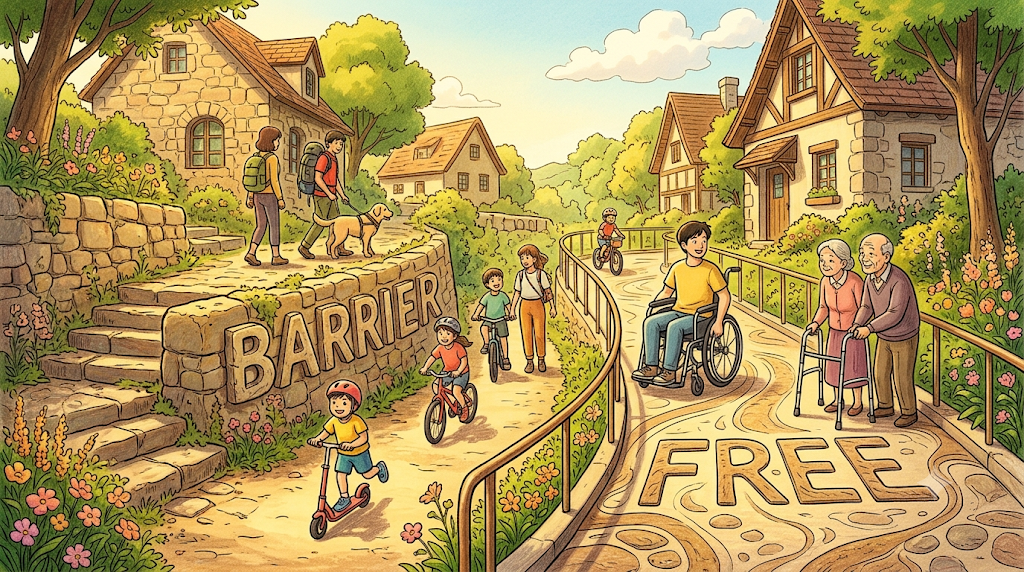
barrier free [ˈbæriər friː]
품사/뉘앙스 설명
(형용사구) 장벽 없는, 무장애의
장애인이나 노약자 등이 물리적·사회적 장벽 없이 자유롭게 접근하거나 이용할 수 있는 환경을 강조합니다. 장벽 없는 환경이 특정 집단만이 아닌 모두에게 좋다는 것이 핵심 뉘앙스입니다. 수능 독해 사회·교육·복지 지문에서 자주 등장합니다.
- The principle of barrier free design — that products, environments, and communications should be usable by people with the widest possible range of abilities — produces outcomes that benefit not just people with disabilities but the general population: kerb cuts designed for wheelchair users also help people with pushchairs, deliveries, and luggage, and captions designed for the deaf also help people in noisy environments. (장벽 없는 설계의 원칙 — 제품, 환경, 그리고 소통이 가능한 가장 넓은 범위의 능력을 가진 사람들이 사용할 수 있어야 한다 — 은 장애인만이 아닌 일반 인구에게도 혜택을 주는 결과를 만들어낸다: 휠체어 사용자를 위해 설계된 연석 절개도 유모차, 배달, 그리고 수화물을 가진 사람들을 도우며 청각 장애인을 위해 설계된 자막도 시끄러운 환경의 사람들을 돕는다.)
- Creating genuinely barrier free digital spaces — websites and applications that people with visual, auditory, motor, and cognitive disabilities can use as effectively as those without disabilities — requires integrating accessibility into the design process from the beginning rather than retrofitting it as an afterthought, yet many organisations still treat accessibility as an optional feature rather than a basic requirement. (진정으로 장벽 없는 디지털 공간을 만드는 것 — 시각, 청각, 운동, 그리고 인지 장애를 가진 사람들이 장애 없는 사람들만큼 효과적으로 사용할 수 있는 웹사이트와 응용 프로그램 — 은 나중에 추가로 덧붙이기보다 처음부터 설계 과정에 접근성을 통합하는 것을 필요로 하지만 많은 조직이 여전히 접근성을 기본 요건이 아닌 선택적 기능으로 취급한다.)
- The aspiration toward a barrier free society goes beyond physical accessibility to include the removal of social and attitudinal barriers — the assumptions, stereotypes, and low expectations that limit what people with disabilities are perceived to be capable of, and that can be more disabling in practice than the physical limitations they are about. (장벽 없는 사회를 향한 열망은 물리적 접근성을 넘어 사회적이고 태도적 장벽들의 제거를 포함한다 — 장애인이 할 수 있다고 인식되는 것을 제한하고 그것들이 다루는 신체적 제한보다 실제로 더 장애가 될 수 있는 가정, 고정관념, 그리고 낮은 기대들이다.)
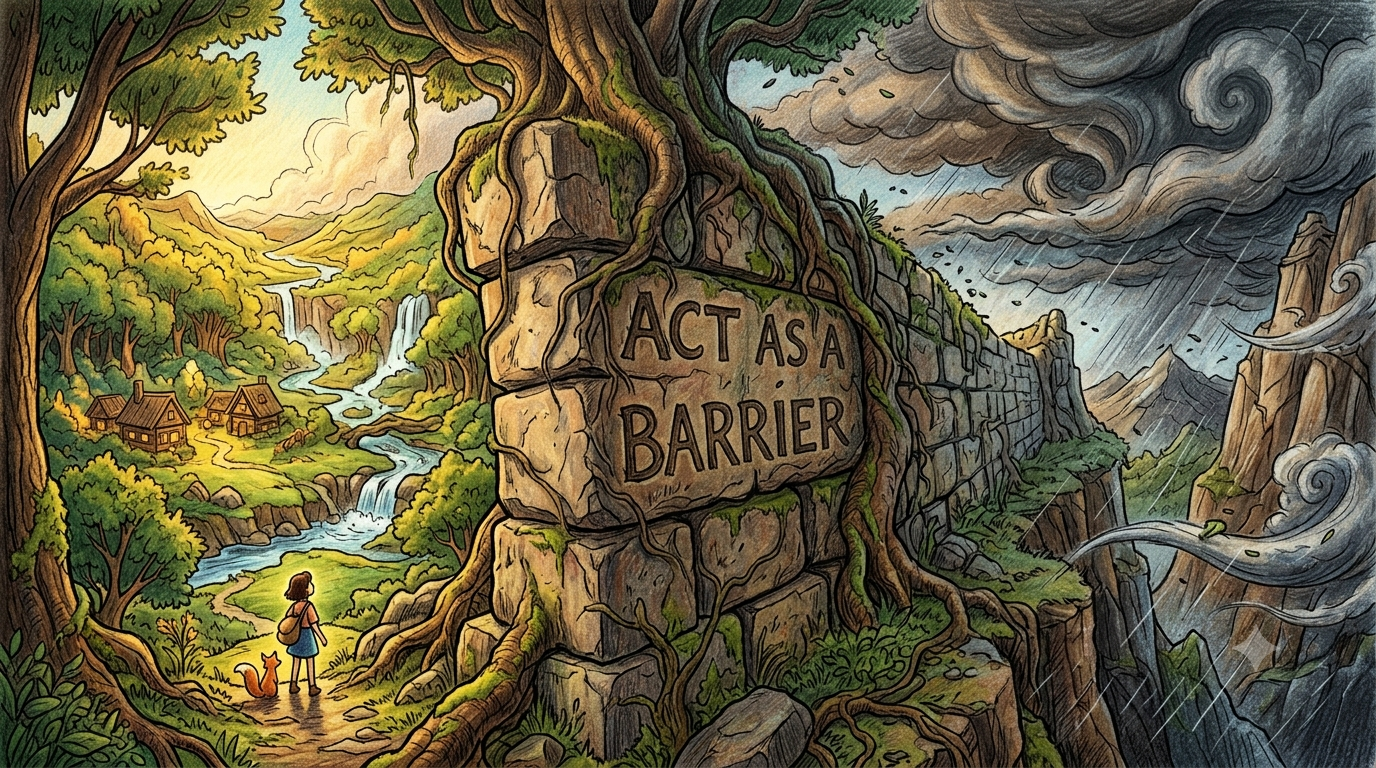
act as a barrier [ækt æz ə ˈbæriər]
품사/뉘앙스 설명
(동사구) 장벽 역할을 하다, 방어막 구실을 하다
어떤 것이 다른 것의 이동이나 접근이나 전파를 막는 역할을 하는 것을 강조합니다. 장벽 역할이 때로 보호이고 때로 차단임이 핵심 뉘앙스입니다. 수능 독해 과학·사회·환경 지문에서 자주 등장합니다.
- The mucous membranes lining the respiratory and digestive tracts act as barriers against pathogens in ways that are more complex than simple physical exclusion — they also contain immune cells and produce antimicrobial substances, and the microbiome that colonises these surfaces provides additional protection by competing with pathogens for space and nutrients. (호흡기와 소화관을 안쪽에서 감싸는 점막은 단순한 물리적 차단보다 더 복잡한 방식으로 병원체에 대한 장벽 역할을 한다 — 그것들은 또한 면역 세포를 포함하고 항균 물질을 생성하며, 이 표면에 군집하는 마이크로바이옴이 공간과 영양소를 두고 병원체와 경쟁함으로써 추가적인 보호를 제공한다.)
- Strong professional norms and ethics codes act as barriers against corrupt practices within occupations — not by making corruption impossible but by raising the psychological cost of engaging in it, by creating a culture in which such behaviour is stigmatised by colleagues, and by providing a clear framework against which deviations can be identified and addressed. (강한 전문적 규범과 윤리 강령은 직업 내의 부패 관행에 대한 장벽 역할을 한다 — 부패를 불가능하게 만들어서가 아니라 그것에 참여하는 심리적 비용을 높이고, 그러한 행동이 동료들에 의해 낙인찍히는 문화를 만들며, 이탈이 파악되고 다뤄질 수 있는 명확한 틀을 제공함으로써이다.)
- Border controls act as barriers not just against the movement of people and goods but also against the spread of plant and animal diseases — the biosecurity measures at international entry points, often invisible to travellers, represent one of the few mechanisms that can slow the natural tendency of pathogens to follow the movement of their hosts across national boundaries. (국경 통제는 사람과 상품의 이동만이 아니라 식물과 동물 질병의 확산에 대한 장벽 역할도 한다 — 국제 입국 지점에서의 생물 보안 조치들은 여행자들에게 종종 보이지 않지만 병원체가 국경을 넘어 숙주의 이동을 따르는 자연적인 경향을 늦출 수 있는 몇 안 되는 메커니즘 중 하나를 나타낸다.)
숙어 그룹 묶음 1 — 사람 사이의 장벽 barrier 핵심 패턴
표현 의미 핵심 뉘앙스 주요 맥락
| language barrier | 언어 장벽 | 단순한 소통 문제를 넘어 사회적 통합 문제 | 사회·교육·심리 |
| cultural barrier | 문화 장벽 | 의도하지 않게 만들어지는 보이지 않는 장벽 | 사회·교육·역사 |
| barrier between | ~ 사이의 장벽 | 장벽이 양쪽 모두에 영향을 줌 | 사회·심리·역사 |
이 세 표현은 모두 barrier의 "사람들 사이의 연결과 이해를 막는" 이미지를 공유하되, 각각 서로 다른 언어를 사용하는 사람들 사이의 소통 장벽(language barrier)·서로 다른 문화적 배경으로 인한 이해 장벽(cultural barrier)·두 사람이나 집단이나 상태 사이를 가로막는 장벽(barrier between)의 관점에서 접근합니다.
- The language barrier and cultural barrier between communities are often inseparable — language carries cultural assumptions, and breaking down the language barrier does not automatically break down the cultural barrier between groups, since the same words can carry very different implications in different cultural contexts. (언어 장벽과 지역 사회들 사이의 문화적 장벽은 종종 분리할 수 없다 — 언어는 문화적 가정을 담고 있으며 언어 장벽을 허무는 것이 자동으로 집단들 사이의 문화적 장벽을 허무는 것이 아닌데 같은 단어가 다른 문화적 맥락에서 매우 다른 함의를 가질 수 있기 때문이다.)
- Understanding that the barrier between generations is partly a language barrier — not because the young and old literally speak different languages but because the vocabulary, references, and communication styles that feel natural in each cohort differ significantly — can shift the response from impatience to curiosity about what is actually being meant when familiar words are used differently. (세대 사이의 장벽이 부분적으로 언어 장벽이라는 것을 이해하는 것 — 젊은이와 노인이 글자 그대로 다른 언어를 사용해서가 아니라 각 코호트에서 자연스럽게 느껴지는 어휘, 참고 자료, 그리고 소통 방식이 상당히 다르기 때문에 — 은 친숙한 단어가 다르게 사용될 때 실제로 무엇이 의미되는지에 대한 조급함에서 호기심으로 반응을 바꿀 수 있다.)
- International organisations that work to reduce the cultural barriers and language barriers that create misunderstanding between nations operate on the premise that conflict is often rooted in misperception, and that creating conditions where people can understand each other's perspectives — even when they continue to disagree — reduces the risk that disagreements escalate into hostility. (문화적 장벽과 국가들 사이에 오해를 만드는 언어 장벽을 줄이기 위해 일하는 국제 기구들은 갈등이 종종 오인식에 뿌리를 두고 있으며 사람들이 의견 불일치를 계속할 때도 서로의 관점을 이해할 수 있는 조건을 만드는 것이 의견 불일치가 적대감으로 악화될 위험을 줄인다는 전제에서 운영된다.)
숙어 그룹 묶음 2 — 장벽에 대한 행동 barrier 심화 패턴
표현 의미 핵심 뉘앙스 주요 맥락
| raise a barrier | 장벽을 세우다 | 보호와 차별 사이에 있는 장벽 세우기 | 사회·경제·역사 |
| overcome a barrier | 장벽을 극복하다 | 개인의 노력과 구조적 지원 모두 필요 | 사회·심리·교육 |
| break down barriers | 장벽을 허물다 | 장벽이 허물어진 후 새로운 연결이 생김 | 사회·교육·심리 |
이 세 표현은 모두 barrier에 대한 행동의 이미지를 공유하되, 각각 장벽을 의도적으로 만들거나 높이는 것(raise a barrier)·이미 있는 장벽을 이겨내고 나아가는 것(overcome a barrier)·장벽을 제거하여 연결을 회복하는 것(break down barriers)의 관점에서 접근합니다.
- The sequence matters: when societies raise barriers that cannot be overcome by those affected, the moral and practical imperative to break those barriers down grows stronger over time — the history of civil rights movements illustrates that barriers raised to protect privilege eventually become barriers broken by those they excluded. (순서가 중요하다: 사회가 영향받는 사람들이 극복할 수 없는 장벽을 세울 때 그 장벽들을 허무는 도덕적이고 실질적인 의무가 시간이 지나면서 더 강해진다 — 시민권 운동의 역사는 특권을 보호하기 위해 세워진 장벽들이 결국 그들이 배제한 사람들에 의해 허물어지는 장벽들이 된다는 것을 보여준다.)
- Policies designed to help individuals overcome barriers are more effective when they are combined with efforts to break down the structural barriers themselves — providing ladders over walls is valuable but not a substitute for raising the question of why the walls were raised in the first place. (개인이 장벽들을 극복하도록 돕기 위해 설계된 정책들은 구조적 장벽들 자체를 허무는 노력과 결합될 때 더 효과적이다 — 벽 위로 사다리를 제공하는 것은 가치 있지만 애초에 왜 벽이 세워졌는지를 묻는 질문의 대체물이 아니다.)
- When competition raises barriers to entry that legitimate competitors cannot overcome, breaking down those barriers requires regulatory intervention — the market mechanisms that normally erode monopolistic advantages do not function when the barriers themselves prevent the competition that would erode them. (경쟁이 합법적인 경쟁자들이 극복할 수 없는 진입 장벽을 세울 때 그 장벽들을 허무는 것은 규제 개입을 필요로 한다 — 장벽들 자체가 그것들을 침식할 경쟁을 막을 때 독점적 이점을 정상적으로 침식하는 시장 메커니즘이 기능하지 않는다.)
숙어 그룹 묶음 3 — 장벽의 기능과 접근 barrier 심화 패턴
표현 의미 핵심 뉘앙스 주요 맥락
| barrier to | ~에 대한 장벽 | 구조적이어서 개인의 노력만으로 넘기 어려움 | 사회·교육·경제 |
| trade barrier | 무역 장벽 | 의도한 보호 효과와 의도하지 않은 비용 | 경제·사회·역사 |
| barrier free | 장벽 없는 | 특정 집단만이 아닌 모두에게 좋음 | 사회·교육·복지 |
이 세 표현은 모두 barrier의 "접근이나 흐름을 막는 것의 여부와 정도" 이미지를 공유하되, 각각 어떤 것의 달성이나 접근을 막는 구체적인 장애물(barrier to)·국가 간 상품이나 서비스 이동을 제한하는 것(trade barrier)·장벽이 없어서 자유롭게 접근할 수 있는 상태(barrier free)의 관점에서 접근합니다.
- The goal of a truly barrier free society requires not just removing barriers to specific activities but reconceiving what counts as access — when the standard is set by the typical rather than the full range of human variation, environments and systems that appear barrier free to most people continue to function as barriers for those who fall outside the norm. (진정으로 장벽 없는 사회의 목표는 단순히 특정 활동에 대한 장벽들을 제거하는 것이 아니라 접근으로 무엇을 계산하는지를 재고하는 것을 필요로 한다 — 기준이 인간 변이의 전체 범위가 아닌 전형적인 것에 의해 설정될 때 대부분의 사람들에게 장벽 없어 보이는 환경과 시스템이 규범 밖에 있는 사람들에게 장벽으로 계속 기능한다.)
- Trade barriers can function both as barriers to economic development (when they prevent integration into global markets) and as protections that make it possible to pursue development strategies (when they allow infant industries to develop without being immediately overwhelmed by established competitors) — which interpretation is more accurate depends heavily on context. (무역 장벽은 경제 발전에 대한 장벽으로 (글로벌 시장으로의 통합을 막을 때) 그리고 발전 전략을 추구하는 것을 가능하게 하는 보호로 (유치 산업이 확립된 경쟁자들에 의해 즉각적으로 압도되지 않고 발전할 수 있게 할 때) 모두 기능할 수 있다 — 어느 해석이 더 정확한지는 맥락에 크게 달려있다.)
- Making environments barrier free is one of the most concrete and measurable ways to reduce barriers to full social participation — physical accessibility is neither sufficient nor necessary for complete inclusion, but it is a precondition for many other forms of participation, and the trade barriers that sometimes limit access to assistive technologies further compound the disadvantage faced by people in lower-income countries. (환경을 장벽 없게 만드는 것은 완전한 사회 참여에 대한 장벽들을 줄이는 가장 구체적이고 측정 가능한 방법 중 하나이다 — 물리적 접근성은 완전한 포함을 위해 충분하거나 필요하지 않지만 다른 많은 형태의 참여를 위한 전제 조건이며, 때로 보조 기술에 대한 접근을 제한하는 무역 장벽들이 저소득 나라의 사람들이 직면하는 불이익을 더욱 복합시킨다.)
숙어 그룹 묶음 4 — 보호와 차단의 기능 barrier 완성 패턴
표현 의미 핵심 뉘앙스 주요 맥락
| act as a barrier | 장벽 역할을 하다 | 보호이기도 하고 차단이기도 함 | 과학·사회·환경 |
| break down barriers | 장벽을 허물다 | 장벽 제거 후 새로운 연결 가능 | 사회·교육·심리 |
| barrier between | ~ 사이의 장벽 | 장벽이 양쪽 모두에 영향을 줌 | 사회·심리·역사 |
이 세 표현은 함께 barrier가 나타내는 차단·허물기·분리라는 스펙트럼을 보여줍니다. act as a barrier는 어떤 것이 차단하는 역할을 수행하는 것을, break down barriers는 그 차단을 제거하는 것을, barrier between은 두 영역을 분리하는 경계를 각각 강조합니다.
- The same institution can simultaneously act as a barrier between the public and harmful actors while also acting as a barrier to legitimate access — government bureaucracy, professional licensing, and security screening all break down barriers in some respects (protecting the public) while raising barriers in others (restricting access), and the challenge of good institutional design is calibrating this balance appropriately. (같은 기관이 대중과 해로운 행위자들 사이의 장벽 역할을 하면서 동시에 합법적인 접근에 대한 장벽 역할도 할 수 있다 — 정부 관료제, 전문적 면허, 그리고 보안 심사는 모두 어떤 면에서는 장벽을 허물고 (대중 보호) 다른 면에서는 장벽을 세운다 (접근 제한) — 좋은 기관 설계의 도전은 이 균형을 적절하게 조정하는 것이다.)
- Natural features that act as barriers between populations — rivers, mountain ranges, and seas — can protect biodiversity by enabling distinct species to evolve in isolation, but the same features that break down barriers through climate change, invasive species, or human-built connections can then expose previously isolated populations to competition and disease for which they have no evolved defences. (인구 사이의 장벽 역할을 하는 자연 지형 — 강, 산맥, 그리고 바다 — 은 분리 속에서 뚜렷한 종들이 진화할 수 있게 함으로써 생물다양성을 보호할 수 있지만 기후 변화, 침입종, 또는 인간이 만든 연결을 통해 장벽들을 허무는 같은 지형이 이전에 격리됐던 인구를 진화된 방어 능력이 없는 경쟁과 질병에 노출시킬 수 있다.)
- Breaking down barriers between professional disciplines — allowing knowledge and methods to flow across the barriers that normally separate them — has produced some of the most significant scientific advances of recent decades, but it requires individuals who are willing to act as barriers against the intellectual parochialism of their home disciplines even at the cost of their careers within those disciplines. (전문 분야들 사이의 장벽을 허무는 것 — 지식과 방법이 그것들을 정상적으로 분리하는 장벽들을 넘어 흐르도록 허용하는 것 — 은 최근 수십 년의 가장 중요한 과학적 발전 중 일부를 만들어냈지만 그것들 분야 내의 경력 비용에도 불구하고 자신의 고향 분야의 지적 지방주의에 대한 장벽 역할을 기꺼이 하는 개인들을 필요로 한다.)
전체 요약표
표현 의미 핵심 뉘앙스
| barrier | 장벽, 장애물, 방해물 | 막대기를 가로질러 놓아 그 선을 넘지 못하게 하는 경계선의 이미지 |
| barrier to | ~에 대한 장벽 | 구조적이어서 개인의 노력만으로 넘기 어려움 |
| break down barriers | 장벽을 허물다 | 장벽이 허물어진 후 새로운 연결이 생김 |
| language barrier | 언어 장벽 | 단순한 소통 문제를 넘어 사회적 통합 문제 |
| trade barrier | 무역 장벽 | 의도한 보호 효과와 의도하지 않은 비용 |
| overcome a barrier | 장벽을 극복하다 | 개인의 노력과 구조적 지원 모두 필요 |
| barrier between | ~ 사이의 장벽 | 장벽이 양쪽 모두에 영향을 줌 |
| cultural barrier | 문화 장벽 | 의도하지 않게 만들어지는 보이지 않는 장벽 |
| raise a barrier | 장벽을 세우다 | 보호와 차별 사이에 있는 장벽 세우기 |
| barrier free | 장벽 없는 | 특정 집단만이 아닌 모두에게 좋음 |
| act as a barrier | 장벽 역할을 하다 | 보호이기도 하고 차단이기도 함 |
유의어 비교표
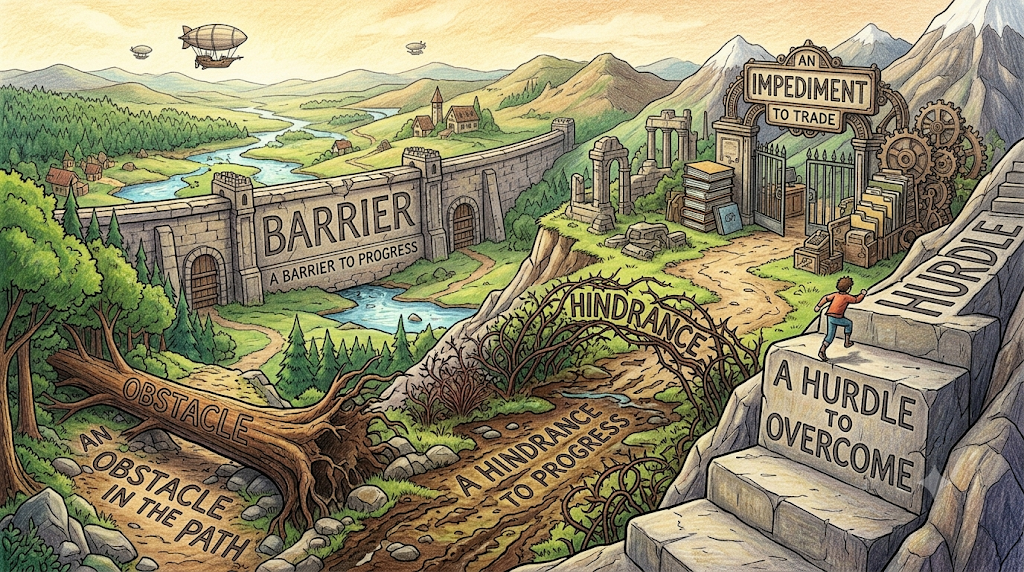
단어 공통점 뉘앙스 차이 예문
| barrier | 방해 관련 | 흐름이나 이동이나 연결을 막는 구조적이고 지속적인 경계 강조 | a barrier to progress |
| obstacle | 방해 관련 | 앞길을 막고 있어서 넘어서거나 피해야 하는 구체적이고 개별적인 어려움 강조 | an obstacle in the path |
| hindrance | 방해 관련 | 완전히 막지는 않지만 방해하고 늦추는 것 강조 | a hindrance to progress |
| impediment | 방해 관련 | 진행이나 발전을 막거나 늦추는 공식적이고 구조적인 방해물 강조 | an impediment to trade |
| hurdle | 방해 관련 | 넘어야 하는 도전이나 어려움, 특히 달성 과정의 단계적 장애 강조 | a hurdle to overcome |
결론 정리
barrier는 단순히 "장벽"이 아니라, 막대기를 가로질러 놓아 아무것도 그 선을 넘지 못하게 하는 것처럼 사람이든, 물건이든, 생각이든, 기회든 어떤 것이 한쪽에서 다른 쪽으로 자유롭게 이동하거나 연결되는 것을 막는 경계선이나 방해물의 이미지에서 출발해 ~에 대한 장벽·장벽을 허물다·언어 장벽·무역 장벽·장벽을 극복하다·~ 사이의 장벽·문화 장벽·장벽을 세우다·장벽 없는·장벽 역할을 하다까지 확장되는 단어다 — barrier가 있는 곳엔 언제나 '울타리가 사람이나 동물이 경계를 넘는 것을 막는 것처럼, 눈에 보이든 보이지 않든 어떤 흐름이나 이동이나 연결이 자유롭게 이루어지지 못하도록 그 경계에서 차단하는' 구조적 방해의 이미지가 있다.
💡 barrier는 "어떤 것의 흐름이나 이동이나 연결이 이루어지는 것을 막는 경계선이나 방해물 — 물리적 울타리에서 언어·문화·경제·심리적 장벽까지, 눈에 보이든 보이지 않든 그 경계를 넘는 것을 어렵게 만드는 것을 가리키는" 단어 — barrier to·break down barriers·act as a barrier 가 수능 최빈출. obstacle(구체적 개별 장애물)·hindrance(완전히 막지 않고 방해·늦춤)와의 구별이 핵심 출제 포인트.
🌟 초등학생 버전 barrier는 단순히 "장벽"이 아니에요! barrier to는 도서관에 가서 좋은 책을 읽고 싶은데 읽고 싶은 책들이 모두 어려운 영어로만 쓰여 있어서 아무리 열심히 하고 싶어도 시작조차 못하게 되는 것처럼 하고 싶은 것이 있어도 그 앞에 딱 버티고 서서 나아가지 못하게 만드는 것이고, break down barriers는 처음에 서로 말도 안 하고 따로 밥 먹던 두 반 아이들이 같이 운동회 팀이 되어 함께 연습하고 응원하다 보니 어느새 서로 이름도 알고 같이 웃게 되는 것처럼 원래 사람들 사이를 갈라놓던 벽이 함께하는 경험을 통해 조용히 사라지는 것이에요! 🌍✨


